Cryptocurrency markets offer thousands of digital assets, but not every project has a clear purpose, reliable technology or transparent information. Before buying a cryptocurrency, it is important to understand what you are investing in, how the project operates and what risks could affect its value.
Learning how to research a cryptocurrency can help you make more informed decisions, identify warning signs and avoid relying solely on social media hype or price predictions.
Whether you are exploring Bitcoin, established altcoins or newly launched crypto projects, this guide explains how to do your own research in crypto using practical checks, publicly available information and independent verification tools.
What Does DYOR Mean in Cryptocurrency?
DYOR stands for Do Your Own Research. It is a common expression in the cryptocurrency community that encourages investors to investigate digital assets independently rather than relying entirely on recommendations from influencers, online communities or promotional websites.
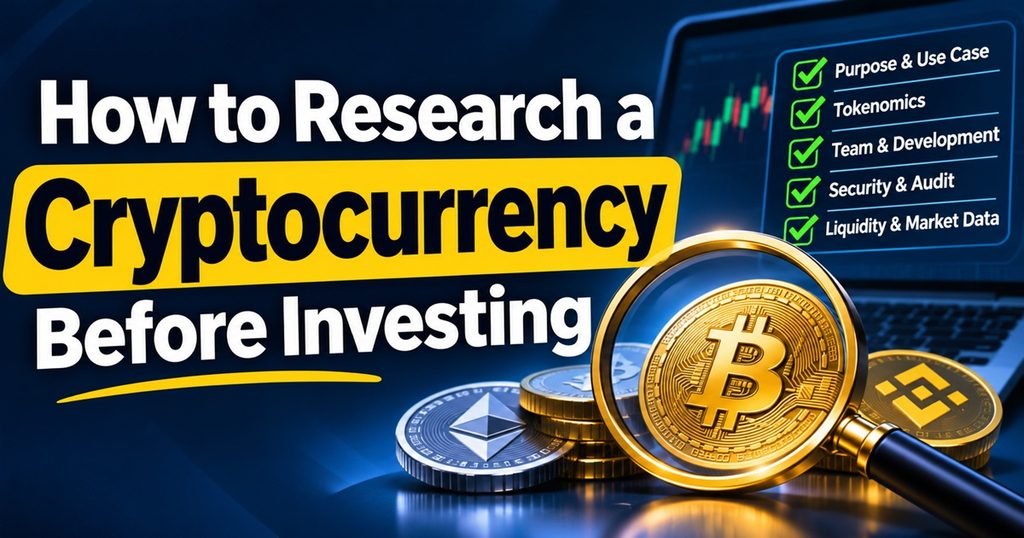
Doing your own crypto research means examining the project’s fundamentals, technology, tokenomics, liquidity, security and development activity.
For example, a cryptocurrency may attract attention because its price has increased rapidly. However, price performance alone does not explain whether the project has genuine utility, sustainable demand or sufficient liquidity for investors to sell their holdings.
A structured research process helps you look beyond price movements.
1. Understand What the Cryptocurrency Actually Does
The first step in researching a crypto coin is understanding its purpose.
Ask yourself:
- What problem is the cryptocurrency designed to solve?
- Does the project offer a product, service or useful technology?
- Why does the project need its own cryptocurrency token?
- Is the product operational, in development or only proposed?
- Are there existing projects offering similar solutions?
Some cryptocurrencies function primarily as payment networks. Others support decentralised applications, governance, blockchain infrastructure or financial services.
A project should explain its purpose in clear language. Complicated terminology is not a substitute for a credible business or technical explanation.
Research tip: If you cannot explain what a cryptocurrency does after reading its website and documentation, investigate further before considering an investment.
2. Read the Cryptocurrency Whitepaper
A whitepaper is a document describing a cryptocurrency project’s objectives, technology, token structure and proposed development.
When learning how to research crypto projects, reviewing the whitepaper is an important step.
Look for information about:
- The project’s purpose and intended users.
- How its blockchain or smart contracts operate.
- The token’s role within the ecosystem.
- Total and circulating token supply.
- Token distribution and allocation.
- Development milestones and technical limitations.
- Governance, security and project risks.
A detailed whitepaper can help you understand a project, but having a whitepaper does not prove that its claims are accurate.
Compare the document with publicly verifiable information, including blockchain transactions, smart contracts and actual product development.
3. Examine Cryptocurrency Tokenomics
Tokenomics refers to the economic design of a cryptocurrency, including its supply, distribution, incentives and intended uses.
Understanding tokenomics is especially important when researching new cryptocurrencies or smaller altcoins.
Important tokenomics questions
Total supply: How many tokens exist or can eventually exist?
Circulating supply: How many tokens are currently available in the market?
Token allocation: What percentage is held by founders, developers, investors, community members or treasury wallets?
Vesting schedules: Are large token allocations locked, and when can they become transferable?
Token utility: Is the cryptocurrency required for a meaningful function within its ecosystem?
Inflation or emissions: Can additional tokens be created, potentially diluting existing holders?
A cryptocurrency with a limited supply is not automatically valuable. Demand, utility, liquidity and holder distribution also matter.
Large concentrations of tokens in a small number of wallets can create additional risks, particularly if those holders can sell significant amounts.
4. Check Market Capitalisation and Trading Liquidity
Market capitalisation and liquidity are different measures, but both are important when researching cryptocurrency coins.
Market capitalisation is generally calculated by multiplying circulating supply by the current market price.
Liquidity describes how easily an asset can be bought or sold without causing a substantial price movement.
A token may display a large market capitalisation while having relatively little liquidity available for trading.
Why liquidity matters
Imagine a cryptocurrency has a liquidity pool worth $10,000. A trader attempting to sell several thousand dollars’ worth of tokens could significantly affect the market price, depending on the pool’s structure and available reserves.
This is known as price impact. Traders may also experience slippage, where the execution price differs from the price they expected.
Before investing, investigate:
- Which exchanges support the token?
- How much trading liquidity is available?
- Is reported trading volume credible?
- How much price impact would a realistic trade create?
- Are liquidity providers able to withdraw their funds?
- Are any liquidity locks independently verifiable?
Important: High reported trading volume does not necessarily mean a token has deep or reliable liquidity.
5. Verify the Smart Contract and Blockchain Activity
For cryptocurrencies issued as tokens on an existing blockchain, the smart contract address is one of the most important pieces of information to verify.
Fraudulent tokens sometimes imitate legitimate projects by using similar names, symbols or logos.
Before interacting with a token, obtain its official contract address and compare it against reliable sources.
Useful blockchain explorers include:
Depending on the blockchain and token, these tools may help you examine transactions, token holders, contract code and other on-chain activity.
What should you investigate?
Check whether the contract source code is verified, whether ownership permissions exist and whether privileged accounts can change important token settings.
For example, some token contracts may permit administrators to mint tokens, pause transfers, blacklist wallets or modify trading fees.
Not every administrative function is automatically malicious, but investors should understand what powers exist and who controls them.
Remember: Verified contract source code means the published code matches the deployed contract. It does not mean the contract is safe or independently audited.
6. Investigate the Project Team and Development Activity
When researching a crypto project, look beyond its website and marketing materials.
Investigate whether the team provides credible information about its experience, responsibilities and development work.
Questions worth asking include:
- Are the founders or developers identifiable?
- Can their professional claims be independently verified?
- Does the project publish meaningful development updates?
- Are roadmap milestones supported by actual deliverables?
- Is there evidence of a working product?
- Does the project communicate openly about delays or technical problems?
Some legitimate cryptocurrency projects have anonymous development teams. However, anonymity can make accountability and independent verification more difficult.
If a project publishes software through GitHub or another public repository, review whether development activity appears consistent with its claims.
Frequent updates alone do not establish quality. The substance of the work matters more than the number of commits or announcements.
7. Research the Cryptocurrency Community
Online communities can provide useful information, but they should not be treated as independent proof of a project’s legitimacy.
When researching cryptocurrency on Reddit, X, Telegram or Discord, look for discussions that address technical questions, risks and project progress.
Consider whether community members can ask difficult questions without being silenced.
Be cautious of:
- Repeated promises of guaranteed profits.
- Pressure to buy immediately.
- Unexplained claims of exchange listings or partnerships.
- Accounts posting identical promotional messages.
- Communities that discourage reasonable criticism.
- Influencers who do not disclose paid promotions.
Reddit discussions can reveal investor concerns or user experiences, but anonymous comments may be inaccurate, biased or deliberately misleading.
Use community discussions to identify questions that require further verification—not as your only research source.
8. Understand Cryptocurrency Security Risks
Even a project with a clear purpose and active development may face security risks.
Before buying, investigate whether the project has undergone an independent smart contract audit, where applicable.
An audit may identify vulnerabilities, but it cannot guarantee that a project will remain secure.
Other important risks include:
Smart contract vulnerabilities: Programming errors or design flaws may expose funds to theft or loss.
Private key compromise: Attackers who gain access to private keys may control associated assets.
Centralisation risks: A small group may control critical contracts, infrastructure or governance decisions.
Liquidity risks: Limited liquidity may make it difficult to sell without substantial losses.
Market volatility: Cryptocurrency prices can change dramatically, even when the underlying technology continues operating.
Regulatory risks: Legal requirements and restrictions may affect how cryptocurrencies are traded or used.
Understanding these risks is an essential part of doing your own research on cryptocurrency.
9. Compare the Project With Other Cryptocurrencies
A useful way to research altcoins is to compare them with established competitors.
For example, if a project claims to provide faster transactions or lower fees, investigate whether those benefits are measurable and meaningful.
Compare projects using consistent criteria:
| Research factor | Questions to ask |
|---|---|
| Purpose | What does the project offer? |
| Adoption | Are people actually using it? |
| Technology | Is the product functional and independently verifiable? |
| Tokenomics | How are tokens supplied and distributed? |
| Liquidity | Can users trade without excessive price impact? |
| Security | What risks, permissions and audit findings exist? |
| Development | Has the team delivered its stated milestones? |
| Transparency | Can important claims be independently checked? |
Avoid comparing cryptocurrencies solely by their token prices.
A coin trading at $0.001 is not necessarily cheaper or more undervalued than one trading at $100. Supply, valuation, liquidity and fundamentals all affect how those prices should be interpreted.
10. Review the Project’s Roadmap and Previous Achievements
A cryptocurrency roadmap describes planned development milestones.
However, future plans should be distinguished from completed work.
When researching new crypto projects, compare the roadmap against actual releases, product demonstrations and publicly verifiable progress.
A useful roadmap should provide meaningful information about what the project intends to build and how progress can be assessed.
Be cautious when a project repeatedly announces ambitious plans without demonstrating measurable development.
Missed deadlines do not automatically indicate fraud, but repeated unexplained delays may warrant closer investigation.
How to Research a New Cryptocurrency Before Buying
If you are investigating a newly launched token, use the following checklist before making a decision.
Cryptocurrency Research Checklist
- I understand what the project does and why its token exists.
- I have reviewed the website and whitepaper.
- I have checked token supply and holder distribution.
- I have verified the official contract address.
- I understand any important contract permissions.
- I have investigated trading liquidity and potential slippage.
- I have reviewed security information and audit findings, if available.
- I have checked development progress and roadmap claims.
- I have looked for independent information and credible criticism.
- I understand that I could lose my entire investment.
You do not need to become a blockchain developer to conduct useful research. However, you should understand the limitations of your knowledge and avoid treating information you cannot verify as established fact.
Applying These Research Principles to Fortis Crypto
The same research standards should apply to every cryptocurrency, including Fortis Crypto ($FTS).
If you are evaluating Fortis, begin with its published project information and compare the claims with independently available evidence.
You can explore:
- Fortis Cryptocurrency Whitepaper — review the project’s documented objectives and technical information.
- Fortis Tokenomics — examine published token supply and allocation information.
- Fortis Development Roadmap — understand the project’s stated plans.
- Fortis Live Price and Chart — explore available market information.
These pages provide starting points for research, not independent verification or a recommendation to invest.
You should also verify relevant blockchain data, assess available liquidity and consider the risks associated with smaller cryptocurrency projects.
An informed investment decision should be based on evidence, not promises of future returns.
Frequently Asked Questions
How do you research a cryptocurrency before investing?
Start by understanding the project’s purpose, reading its whitepaper, reviewing tokenomics and checking the smart contract. Then investigate liquidity, security, development progress and independent sources before considering whether the risks are acceptable.
How do I do my own research in crypto?
Doing your own research, or DYOR, involves independently checking a cryptocurrency’s claims rather than relying on promotional content. Use official documentation, blockchain explorers, credible reporting and verifiable project activity.
How can beginners research crypto coins?
Beginners should first understand cryptocurrency basics, wallets and blockchain transactions. Then use a structured checklist to examine the coin’s purpose, supply, liquidity and risks.
How do you research new crypto projects?
For newer projects, pay particular attention to contract permissions, token allocation, liquidity, team transparency and whether the product actually exists. Newly launched tokens may have limited operating histories, making independent verification especially important.
Is Reddit reliable for cryptocurrency research?
Reddit can help identify community concerns and different viewpoints, but it is not a reliable standalone source of investment information. Verify important claims using independent evidence.
What is the most important thing to check before buying an altcoin?
There is no single factor that guarantees safety. A sensible starting point is to verify the correct token contract, understand the tokenomics, assess liquidity and investigate potential security risks.
Can doing your own crypto research prevent losses?
No. Research can help identify risks and avoid some poor decisions, but it cannot eliminate market volatility, security failures or unexpected events. Cryptocurrency investments can result in substantial or total losses.
Final Thoughts
Learning how to research a cryptocurrency is one of the most valuable skills for anyone exploring digital assets.
Instead of focusing only on price predictions or social media excitement, examine what a project actually offers, how its token works, whether its claims can be verified and what risks could affect investors.
Whether you are researching Bitcoin, established altcoins or emerging cryptocurrency projects, a consistent research process can help you make more informed decisions.
Good crypto research is not about finding a guaranteed winner. It is about understanding what you are buying, identifying uncertainty and making decisions with realistic expectations.