Finding new crypto coins early involves looking beyond major exchange listings and researching projects while they are still launching, building liquidity or attracting their first users. You can discover emerging tokens through blockchain explorers, decentralised exchange trackers, launch announcements and cryptocurrency communities.
But finding a token early is not the same as finding a good investment. Some newly launched cryptocurrencies have limited liquidity, concentrated ownership, unverified contracts or little evidence of a working project.
The challenge is knowing where to look, how to tell whether a coin is genuinely new and what to check before risking your money.
This guide explains how to find new crypto coins before they become widely known, where to track upcoming and recently launched tokens, and how to investigate a project’s contract, trading activity and liquidity. It also includes a practical research process you can repeat without relying on social media hype or price predictions.
If you’re unfamiliar with blockchain networks, token contracts or decentralised trading, start with our guide explaining what cryptocurrency is and how it works. Understanding these basics makes it easier to investigate newly launched tokens.
Where to Find New Crypto Coins Early
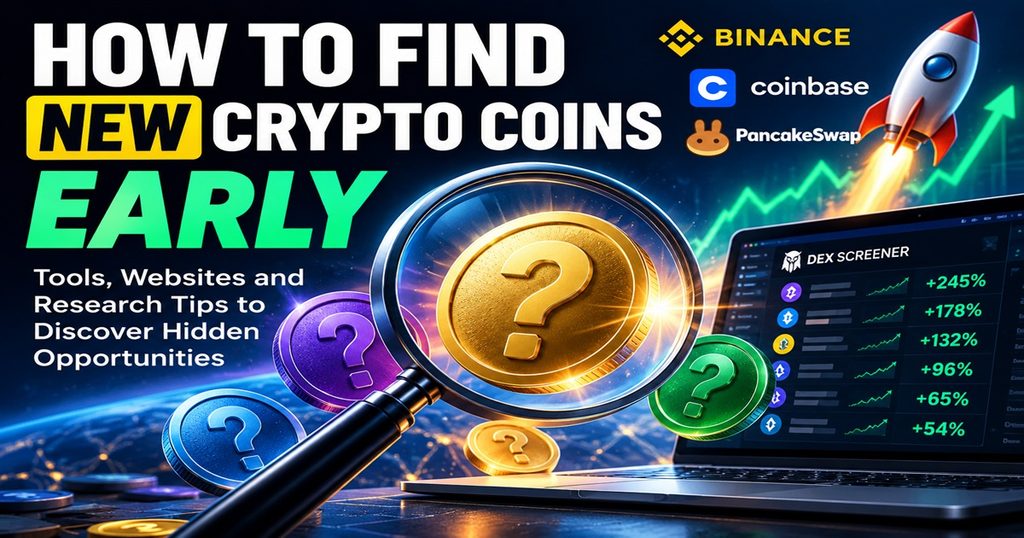
New cryptocurrencies do not all appear in the same place. Some begin trading on decentralised exchanges before appearing on major tracking websites. Others announce upcoming launches through official project channels, while certain tokens first become widely visible after an exchange listing.
If you want to find new crypto coins early, it helps to understand the difference between a token being created, becoming tradable and getting listed on a major exchange. These events can happen at different times.
1. Discover recently launched tokens on DEX Screener
DEX Screener tracks trading pairs across supported blockchain networks. It is useful for finding tokens that have begun trading on decentralised exchanges.
To research a new token:
- Visit DEX Screener and select the blockchain you want to investigate.
- Explore available token pairs and their creation dates.
- Check when the trading pair was created, rather than relying only on the token’s name or promotional claims.
- Examine liquidity, trading volume, transaction activity and price history.
- Copy the token’s contract address and verify it using the relevant blockchain explorer.
A recently created trading pair does not necessarily mean the cryptocurrency itself is new. An older token may have been added to another exchange or paired with a different asset.
Also, a token appearing on DEX Screener does not mean it has been reviewed or approved as an investment.
2. Find recently added cryptocurrencies on CoinGecko
CoinGecko maintains a page showing cryptocurrencies recently added to its tracking platform.
This is useful for discovering projects that have become visible to a wider audience, although the date a cryptocurrency appears on CoinGecko is not necessarily its original launch date.
When comparing projects, look beyond the price. Consider trading volume, blockchain network, market valuation, liquidity and the availability of verifiable project information.
A token with a large percentage price increase may still have limited liquidity or concentrated ownership.
3. Research upcoming cryptocurrency launches
To find upcoming crypto coins before they begin trading, investigate project announcements, launch calendars and official documentation.
Look for information such as:
- The proposed launch date and blockchain network.
- Whether the token contract has already been deployed.
- How tokens will be distributed.
- Whether a public sale, presale or liquidity launch is planned.
- The project’s development history and published documentation.
Treat unconfirmed launch dates cautiously. A project may postpone its launch, change its token contract or never launch at all.
Finding a cryptocurrency before its public launch may provide more research time, but it also means less information may be available to verify its claims.
4. Use Reddit and cryptocurrency communities for discovery
Reddit, developer communities and project discussion channels can help you discover cryptocurrencies that have not yet attracted widespread attention.
However, community popularity should be treated as a research lead, not evidence of legitimacy.
Before investigating a project further, ask whether its claims can be verified outside its own community. Anonymous promotional posts, coordinated enthusiasm and screenshots of supposed profits are not reliable evidence of future performance.
5. Check blockchain explorers before relying on announcements
A blockchain explorer allows you to investigate information recorded on a supported blockchain.
For example, BscScan can help users examine BNB Smart Chain token contracts, transactions and holder addresses.
Once you identify a project, verify its contract address using an official source and investigate the information available on-chain.
Be careful with tokens that share the same name or symbol. Cryptocurrency names are not unique, and imitation tokens may appear alongside legitimate projects.
The key principle: Use discovery platforms to find candidates, then use independent evidence to investigate them. A token being new, trending or recently listed is not proof that it is safe or likely to increase in value.
How to Tell Whether a Crypto Coin Is Actually New
A cryptocurrency appearing on a trending list or exchange announcement does not necessarily mean it has just launched. Some tokens exist for months or years before attracting attention, while others appear new because a trading pair was recently created.
If you’re trying to find new crypto coins early, understanding the different stages of a token’s launch can help you avoid mistaking an old project for a new opportunity.
The Four Dates That Reveal a Token’s History
| Event | What it tells you | Where to investigate |
|---|---|---|
| Contract deployment | When a token’s smart contract was created on a particular blockchain | Blockchain explorer |
| Liquidity pool creation | When a trading pool was established on a decentralised exchange | DEX tracker or blockchain explorer |
| First recorded trade | When trading activity began in the market or pool being examined | Trading history or blockchain explorer |
| Exchange listing | When a particular exchange made the token available | Official exchange announcement |
These dates may be close together, but they can also be separated by months or years.
For example, imagine discovering a token that appears on a recently added cryptocurrency list:
- January: The token contract was deployed.
- February: A liquidity pool was created.
- March: Trading activity began.
- October: The token appeared on a major exchange.
Someone discovering the project in October might assume it is a newly launched cryptocurrency. In reality, it has already been trading for several months.
This is a hypothetical example to illustrate how launch dates can differ.
How to Investigate a Token’s Age
Start by finding the token’s correct contract address through the project’s official website or another independently verifiable source.
Next, open the relevant blockchain explorer and examine the contract’s creation transaction, where available.
Then check decentralised exchange tracking platforms to see when trading pairs were created and when trading activity began.
Finally, compare those dates with official exchange announcements.
Remember that tokens can migrate between contracts or blockchains. A recent contract deployment does not always mean the underlying project is new.
One practical way to discover newly tradable cryptocurrencies is to explore DEX Screener’s New Pairs page, which displays recently created trading pairs across supported blockchain networks. You can examine pair age, liquidity, trading volume and transaction activity before researching a token further. Remember that a newly created trading pair does not necessarily mean the cryptocurrency itself is new.
Why Finding a Coin Early Does Not Guarantee Better Returns
Early discovery can provide more time to research a project, but it does not automatically mean the token is undervalued.
A cryptocurrency can have a low unit price while already carrying a substantial valuation. Early investors may also hold large token allocations, and limited liquidity can make selling difficult.
Instead of asking only, “How early did I find this coin?”, ask:
“What can I independently verify about this project before deciding whether it deserves further research?”
That question is more useful than relying on a token’s launch date, trending position or recent price increase.
How to Research a New Crypto Coin Before Buying
Finding a new cryptocurrency is relatively easy. Determining whether its contract, liquidity and ownership structure present unacceptable risks takes more investigation.
Before buying a newly launched token, examine what can be verified independently. A professional-looking website, active social media account or growing community does not prove that a cryptocurrency is legitimate.
The following research process is particularly useful for tokens launched on BNB Smart Chain and other networks that support smart contracts.
1. Verify the Token’s Contract Address
Start with the cryptocurrency’s official contract address, not its name or ticker symbol.
Different tokens can share identical names and symbols. Scammers sometimes create imitation tokens designed to resemble established projects.
For BNB Smart Chain tokens, use BscScan to examine the contract address. For Ethereum-based tokens, use Etherscan.
Check whether the address matches the one published through the project’s official channels.
Also investigate whether the contract’s source code is verified. Verified source code allows researchers to inspect the published implementation, but it does not mean the contract has passed a security audit or is safe.
Warning sign: Multiple conflicting contract addresses with no credible explanation.
2. Check Liquidity Before Looking at Price Gains
Liquidity affects how easily a cryptocurrency can be bought or sold without substantially moving its price.
Imagine two newly launched tokens:
| Example | Token A | Token B |
|---|---|---|
| Displayed token price | $0.01 | $0.01 |
| Available pool liquidity | $200,000 | $2,000 |
| Recent trading activity | Regular | Limited |
| Potential trading difficulty | Lower, all else equal | Higher |
Figures are hypothetical. Actual execution depends on pool composition, trade size, fees and market conditions.
Although both tokens display the same price, their trading conditions can be very different.
A token with limited liquidity may experience substantial price changes from relatively small trades. Selling a large position can also produce a much lower average execution price than the quoted market price.
Check the liquidity pool’s assets, size, trading history and any available information about who controls the liquidity-provider positions.
3. Investigate Whether Liquidity Can Be Withdrawn
Some cryptocurrency projects lock liquidity-provider tokens or use arrangements intended to restrict liquidity withdrawals.
However, the phrase “liquidity locked” should never be accepted without verification.
Investigate:
- Which liquidity pool is involved.
- What proportion of the relevant liquidity-provider position is locked.
- The contract or service controlling the lock.
- When the restriction expires.
- Whether other liquidity positions remain withdrawable.
A liquidity lock does not prevent every form of manipulation or loss. Token holders may still sell substantial amounts, contract permissions may introduce additional risks, and trading conditions can change.
Important: Locked liquidity is one research factor, not a guarantee that a token is safe.
4. Examine Who Holds the Token Supply
Token ownership concentration can reveal risks that are not obvious from a price chart.
Use a blockchain explorer to review the largest holder addresses.
Pay attention to whether substantial portions of the supply are held by a small number of wallets.
However, do not automatically assume that every large address belongs to an individual investor. Some addresses represent exchange wallets, liquidity pools, vesting contracts or other project infrastructure.
A useful investigation distinguishes between these categories where reliable evidence is available.
Also remember that one person or organisation can control multiple addresses. A holder list cannot always reveal the true distribution of ownership.
5. Check Token Supply and Contract Permissions
Before researching a cryptocurrency’s potential returns, understand how its supply works.
Investigate the total supply, circulating supply where verifiable, and whether additional tokens can be created.
For tokens using programmable smart contracts, examine whether privileged addresses can perform actions such as:
- Minting additional tokens.
- Pausing transfers.
- Restricting particular addresses.
- Changing transaction fees.
- Upgrading contract functionality.
Not every token has these permissions, and their existence does not automatically indicate fraud. However, they can affect the level of control held by project operators.
If the contract uses a proxy or upgradeable architecture, investigate who can authorise upgrades.
6. Check Whether Tokens Can Actually Be Sold
A rising chart does not necessarily mean ordinary buyers can realise the displayed gains.
Some malicious or poorly designed tokens restrict selling, impose unusually high transaction fees or apply different rules to particular addresses.
Research whether independent transactions show successful purchases and sales.
Where appropriate, examine contract behaviour using reputable analysis tools. Automated scanners can identify certain warning signs, but they cannot reliably detect every vulnerability or malicious mechanism.
Never assume a token is safe simply because a scanner displays a favourable result.
7. Investigate the Project Beyond the Blockchain
Blockchain data can reveal important technical details, but it cannot establish whether a project’s business claims are truthful.
Look for evidence of development activity, working products, clear documentation and consistency between public claims and observable results.
Consider whether the project explains how its token is used, how supply is allocated and what risks participants face.
Be cautious when promotional material concentrates on guaranteed profits, urgent buying deadlines or unsupported claims of major exchange listings.
A Practical Research Summary
| Research question | Why it matters |
|---|---|
| Is the contract address authentic? | Helps avoid imitation tokens |
| Is the contract verified and understandable? | Supports independent technical review |
| Is there sufficient liquidity? | Affects trading and exit conditions |
| Who controls liquidity positions? | Reveals potential withdrawal risks |
| Who holds the token supply? | Helps assess ownership concentration |
| Can the token supply or rules change? | Reveals privileged contract permissions |
| Are independent sales taking place? | Helps identify trading restrictions |
| Can project claims be verified? | Helps distinguish evidence from promotion |
No single check can establish that a cryptocurrency is safe or a good investment.
The purpose of researching new crypto coins is to identify risks, challenge assumptions and decide whether further investigation is justified—not to predict which token will increase in price.
Discovering a cryptocurrency and purchasing it are two different steps. If you’re unfamiliar with exchanges, wallets and transactions, our guide on how beginners buy cryptocurrency explains the purchasing process and important considerations.
How to Find New Crypto Coins Before They Reach Major Exchanges
Some cryptocurrencies begin trading on decentralised exchanges (DEXs) long before they become available on platforms such as Binance or Coinbase. Others launch directly through centralised exchanges or remain unavailable for public trading until their official release.
If you want to find new crypto coins before they reach major exchanges, the key is understanding where tokens first become available and how to distinguish confirmed listings from speculation.
1. Look for Tokens Already Trading on Decentralised Exchanges
Decentralised exchanges allow supported tokens to trade through liquidity pools without requiring a traditional centralised exchange listing.
For example, a token on BNB Smart Chain may begin trading through PancakeSwap before being listed on a major centralised exchange.
You can investigate these tokens by:
- Exploring recently created trading pairs on supported DEX tracking platforms.
- Checking the token’s contract address and blockchain network.
- Reviewing when liquidity was added and when trading began.
- Examining transaction activity, holder distribution and available liquidity.
- Researching the project’s official announcements and development history.
A token trading on a DEX is not necessarily scheduled for a Binance or Coinbase listing. Many tokens never receive such listings.
2. Check Official Exchange Listing Announcements
Major cryptocurrency exchanges publish announcements about newly supported assets.
These announcements can help you identify which cryptocurrencies are being added to a platform and when trading is expected to begin.
However, there is an important difference between finding a token before it begins trading on an exchange and discovering it before the exchange publicly announces the listing.
Official announcements provide stronger evidence than rumours, but they may appear after a token has already experienced substantial market activity elsewhere.
Always confirm the trading pair, supported network, deposit arrangements and scheduled trading availability through the exchange’s official channels.
3. Research Upcoming Projects Before Their Token Launch
Some cryptocurrency projects publish information about their proposed tokens before deployment or public trading begins.
This may include technical documentation, token distribution plans, development milestones and intended launch arrangements.
Researching these projects early gives you more time to investigate their claims, but it also introduces additional uncertainty.
A project without a deployed token contract or functioning product may offer limited independently verifiable information.
Treat proposed launch dates, exchange partnerships and future valuations as claims until credible evidence supports them.
4. Understand the Difference Between a Listing Rumour and a Confirmed Listing
Consider three hypothetical situations:
| Situation | What is known | What remains uncertain |
|---|---|---|
| A token is trading on PancakeSwap | A trading pool exists and transactions can be examined | Whether a major exchange will list it |
| A project claims a Binance listing is coming | The project has made an announcement | Whether Binance has confirmed the listing |
| An exchange publishes an official listing notice | The exchange has announced its intended support | Whether trading will begin as scheduled and how the market will respond |
The distinction matters because rumours about major exchange listings can influence speculative trading.
A screenshot, social media post or message from an anonymous account should not be treated as proof of an upcoming listing.
Even an official listing announcement does not guarantee that a cryptocurrency’s price will increase.
5. Avoid Assuming Earlier Always Means Better
Buying a token before a major exchange listing can involve additional risks, including limited liquidity, unreliable pricing, contract vulnerabilities and concentrated ownership.
It is also possible to discover a project early but pay an unfavourable price.
For example, a token might trade on a decentralised exchange at a valuation that already reflects substantial expectations about future growth. A later exchange listing may not justify that valuation.
Instead of focusing entirely on being first, investigate whether the token has a credible purpose, verifiable technical information, reasonable trading conditions and risks you understand.
The practical takeaway: Finding crypto coins before major exchange listings is possible, but no public discovery method can reliably predict which tokens will be listed next. Use decentralised exchange data for discovery, official exchange announcements for confirmation and independent research before making financial decisions.
How to Find New Crypto Tokens on PancakeSwap and BNB Smart Chain
BNB Smart Chain is one of the blockchain networks where new cryptocurrency tokens can begin trading through decentralised exchanges such as PancakeSwap.
Unlike centralised exchanges, where an operator decides which assets to list, permissionless decentralised exchanges can allow users to create trading pools for compatible tokens. This makes them useful for discovering newly tradable cryptocurrencies, but it also means unfamiliar tokens may appear without undergoing a centralised listing review.
If you want to find new crypto tokens on PancakeSwap, the most useful approach is to combine trading-pair discovery with independent blockchain research.
Step 1: Find Newly Created Trading Pairs
Start with a decentralised exchange tracking platform such as DEX Screener.
Select BNB Smart Chain and examine available trading pairs, paying attention to their creation dates.
A recently created pair may indicate that trading has only recently become available through that pool.
However, a new trading pair does not necessarily mean a new cryptocurrency. An existing token may have been paired with another asset or added to a different liquidity pool.
Step 2: Identify the Token’s Contract Address
Once you find a token worth investigating, locate its contract address.
Do not rely on the token name or symbol alone. Different contracts can use identical names, and imitation tokens may be designed to resemble legitimate projects.
Compare the address shown by the trading platform with information published through the project’s official channels.
For BNB Smart Chain tokens, you can then examine the address using BscScan.
Step 3: Examine the Token’s Trading Activity
Before interpreting a token’s price movement, examine the market supporting that price.
Look at:
- The age of the trading pair.
- Available liquidity.
- Trading volume over different periods.
- The number and size of recent transactions.
- Whether independent buying and selling activity is visible.
- Large price movements occurring alongside limited trading activity.
A token with very little liquidity may show dramatic percentage gains even though selling a meaningful position would be difficult.
Also remember that reported trading activity can sometimes be manipulated. Transaction volume alone is not proof of genuine investor demand.
Step 4: Check the Token on BscScan
BscScan provides blockchain records that can help you investigate a BNB Smart Chain token.
Depending on the contract and available information, you may be able to review its deployment history, token transfers, holder addresses and verified source code.
Pay particular attention to privileged contract permissions and large token allocations.
A verified contract allows published source code to be inspected, but verification does not guarantee that the contract is secure.
Step 5: Verify the PancakeSwap Trading Pool
If the token trades through PancakeSwap, examine the relevant pool rather than assuming every trading pair has the same liquidity or risk characteristics.
A cryptocurrency may have multiple pools, each with different liquidity levels and trading conditions.
Check which assets are paired, whether the pool has meaningful liquidity and what can be established about control of the liquidity position.
If a project claims its liquidity is locked, investigate the specific lock arrangement and its expiry conditions.
Do not treat a liquidity-lock claim as proof that a token is safe.
Step 6: Research the Project Before Connecting Your Wallet
Finding a token through a DEX tracker does not require you to connect a wallet or approve a transaction.
You can complete substantial initial research using public blockchain data and official documentation.
Be cautious of unfamiliar websites that ask you to connect your wallet, sign messages or approve token spending simply to view information about a project.
A token approval can grant a smart contract permission to spend specified assets from your wallet. Understand the permissions before approving anything.
What This Method Can and Cannot Tell You
| This research can help reveal | It cannot guarantee |
|---|---|
| Whether a trading pool exists | That the project is legitimate |
| When a particular pool was created | That the token itself is newly created |
| Recorded token transfers and transactions | That all trading activity is genuine |
| Visible holder concentration | The identity of every beneficial owner |
| Certain contract permissions | That the contract has no vulnerabilities |
| Available liquidity at a particular time | That liquidity will remain available |
Finding new tokens on PancakeSwap is therefore best treated as the beginning of the research process, not a shortcut to discovering profitable investments.
The goal is to identify projects early enough to investigate them carefully—not to buy simply because a token has just appeared on a trading platform.
For a project-specific example of blockchain information being published and documented, see the Fortis ecosystem update covering DEXTools and BscScan verification. Remember that token information appearing on a blockchain explorer or tracking platform does not constitute an independent security endorsement.
How to Find New Crypto Coins on Binance and Coinbase
Binance and Coinbase regularly announce support for additional cryptocurrencies. Their official listing announcements can help you discover tokens that are becoming available to a wider market.
However, a newly listed coin is not necessarily a newly launched coin. Some cryptocurrencies trade on other exchanges or decentralised platforms long before Binance or Coinbase adds support.
If you’re looking for new crypto coins on these exchanges, focus on official announcements rather than social media rumours.
How to Find New Coins on Binance
Binance maintains an announcements section where users can find information about newly listed cryptocurrencies, trading pairs and changes to supported assets.
To investigate a new Binance listing:
- Visit the official Binance website and open its announcements section.
- Look for announcements about new cryptocurrency listings.
- Check the cryptocurrency’s name, ticker symbol and supported trading pairs.
- Read the announcement for the intended trading start time, supported networks and any applicable restrictions.
- Research the project independently before deciding whether to trade.
Be careful not to confuse a token launched on BNB Smart Chain with a cryptocurrency listed on the Binance exchange.
BNB Smart Chain is a blockchain network. Binance is a centralised cryptocurrency exchange. A token can exist on BNB Smart Chain without being listed on Binance.
How to Find Out When Coinbase Adds New Coins
Coinbase also publishes official announcements and asset information relating to supported cryptocurrencies.
To research newly added coins:
- Check Coinbase’s official asset listings and announcements.
- Look for information about newly supported cryptocurrencies.
- Verify whether trading is available in your country.
- Check the supported blockchain network and asset details.
- Compare the listing announcement with the token’s existing trading history.
Some cryptocurrencies may be announced before trading begins. Others may already have substantial trading activity on different platforms.
An announcement that Coinbase intends to support an asset should not be interpreted as a guarantee of future price appreciation.
What About Crypto.com?
You can use a similar approach to find new coins on Crypto.com.
Review the platform’s official announcements and supported cryptocurrency information, then confirm whether the asset is available through the particular Crypto.com service you intend to use.
Availability can differ between an exchange, a retail trading application and other services operated under the same brand.
Newly Listed vs Newly Launched: Why It Matters
Imagine two cryptocurrencies appearing in exchange announcements on the same day.
Coin A launched two years ago and has an established trading history. It is only now being added to another exchange.
Coin B began trading recently and has limited publicly available history.
Both may appear in a list of new exchange listings, but only Coin B is a relatively new cryptocurrency.
That difference affects the information available for research. An established token may have years of price history, blockchain activity and development records, while a recently launched token may have little evidence beyond its initial transactions.
Can You Find Coins Before Binance or Coinbase Announces Them?
You can discover cryptocurrencies before they receive major exchange listings by researching decentralised markets, project development and existing trading activity.
However, there is no reliable public method for predicting which tokens Binance or Coinbase will list next.
Be sceptical of accounts claiming to possess guaranteed advance listing information, particularly when they encourage immediate purchases or request payment for supposed insider tips.
A useful strategy is to maintain a research watchlist of projects you have independently investigated, then check official exchange announcements for confirmed developments.
Finding a token before an exchange listing is not proof that it will eventually be listed or become a successful investment.
How to Find New Crypto Coins on Reddit and Social Media
Reddit, X, Telegram and cryptocurrency discussion communities can help you discover emerging projects before they receive widespread coverage. Developers sometimes share project updates, technical discussions and launch announcements long before a cryptocurrency appears on a major exchange.
However, social media is also where misleading promotions, impersonation accounts and coordinated token campaigns can spread quickly.
The most useful approach is to treat community discussions as a source of research leads, not investment recommendations.
1. Search Reddit for Early Project Discussions
Instead of searching only for phrases such as “next 100x crypto”, look for discussions about newly launched tokens, blockchain development and emerging cryptocurrency projects.
Useful Reddit searches include:
- New crypto projects launching
- Recently launched BNB Chain tokens
- Upcoming cryptocurrency launches
- New tokens with working products
- Early-stage blockchain projects
Sort discussions by recent activity when researching new launches, but don’t assume that a highly upvoted post is reliable.
Read the comments critically. Look for specific technical questions, independent research and evidence that participants understand the project.
A discussion containing only price predictions, referral links and repeated promotional messages provides limited useful information.
2. Follow Development Activity, Not Just Announcements
Some cryptocurrency projects publish development updates through GitHub, technical forums or public documentation.
These sources may help you understand whether a project has an identifiable development history.
Look for meaningful changes to software, documented technical decisions and evidence of testing.
However, frequent code commits do not automatically indicate a legitimate project. Activity can be superficial, copied from another repository or unrelated to a functioning product.
Similarly, a project without a public GitHub repository is not necessarily fraudulent. The important question is whether its claims can be independently supported.
3. Use X to Discover Projects, Then Verify Them Elsewhere
X can be useful for finding project announcements, discussions about new blockchain applications and links to technical resources.
Instead of relying on trending hashtags, investigate the source of each claim.
For example, if an account announces that a new cryptocurrency is launching, check whether the project has published verifiable documentation, a contract address or evidence of development.
Be especially cautious of accounts impersonating exchanges, developers or well-known cryptocurrency figures.
4. Recognise Coordinated Promotion
A newly launched cryptocurrency may suddenly appear across dozens of social media accounts.
That activity can reflect genuine interest, paid promotion or coordinated attempts to influence attention.
Potential warning signs include:
- Multiple accounts publishing nearly identical messages.
- Claims that profits are guaranteed.
- Urgent instructions to buy before an alleged major listing.
- Screenshots of supposed returns without verifiable transaction evidence.
- Refusal to answer questions about token supply or liquidity.
- Links to unfamiliar websites requesting wallet connections.
None of these signs alone proves that a project is fraudulent, but they justify additional investigation.
5. Use the Independent Evidence Test
Before adding a cryptocurrency discovered through social media to your research watchlist, ask three questions:
Can I verify the token exists?
Look for the correct contract address and independently inspect the blockchain records.
Can I verify the project’s important claims?
Compare statements about liquidity, supply, partnerships and development with reliable supporting evidence.
Can I identify risks that the promotional material leaves out?
Investigate ownership concentration, trading restrictions, privileged contract permissions and the possibility of substantial losses.
If the available information consists mainly of promotional posts, you may not have enough evidence to assess the project meaningfully.
A Better Way to Use Social Media for Crypto Discovery
Social media is most useful at the beginning of the discovery process.
A practical workflow is:
Community discussion → Project identification → Contract verification → Liquidity and holder research → Independent risk assessment
This separates discovering a cryptocurrency from deciding whether it deserves further attention.
Finding a token before it becomes popular may feel like an advantage, but the quality of your research matters more than how early you encounter its name.
How to Build a New Crypto Coin Watchlist
When researching new cryptocurrencies, it’s easy to lose track of which projects you’ve investigated, where you discovered them and what still needs verification.
A simple watchlist helps you compare projects using consistent information rather than relying on price movements or social media attention.
You don’t need expensive cryptocurrency research software. A spreadsheet or basic document is enough to get started.
A watchlist can include both newly launched cryptocurrencies and more established altcoins. If you want to broaden your research beyond recent launches, explore our guide to evaluating altcoins for additional projects and comparison factors.
What to Record for Every New Cryptocurrency
For each project, record its name, blockchain network, contract address and the date you discovered it.
Then add information about the token’s trading history, liquidity, supply distribution and contract permissions.
The purpose isn’t to predict which cryptocurrency will deliver the highest return. It’s to identify what you know, what remains uncertain and which projects deserve further investigation.
Example: A New Crypto Research Watchlist
The following table uses entirely hypothetical cryptocurrencies to demonstrate how a watchlist might work.
| Research factor | Token A | Token B | Token C |
|---|---|---|---|
| Blockchain | BNB Smart Chain | Ethereum | Solana |
| Trading history | 3 days | 2 weeks | Not trading |
| Contract or token address verified | Yes | Yes | Not confirmed |
| Liquidity | $80,000 | $250,000 | Not applicable |
| Ownership concentration | High | Requires review | Unknown |
| Contract permissions | Requires review | Requires review | Unknown |
| Development evidence | Documentation available | Public updates | Limited information |
| Research status | Investigate further | Investigate further | Insufficient information |
All projects and figures are fictional. The table is an example of research organisation, not an investment comparison.
Notice that the watchlist doesn’t automatically label the token with the highest liquidity as the best investment.
Liquidity is important, but it doesn’t establish whether a cryptocurrency is fairly valued, secure or likely to succeed.
Use Three Research Statuses
Instead of assigning speculative price targets, organise your watchlist into three categories.
Needs verification: You have discovered the project but haven’t independently confirmed important information.
Investigate further: Basic information has been verified, but additional research is needed into its technical design, economics, development or risks.
Insufficient evidence or unacceptable risk: Important claims cannot be verified, or the available information reveals risks outside your acceptable limits.
These categories describe your research progress. They are not recommendations to buy or sell.
Track Changes Rather Than Checking Prices Constantly
One advantage of maintaining a watchlist is that you can focus on meaningful developments.
For example, you might revisit a project when:
- Its token contract is deployed or independently verified.
- A functioning product or significant software update is released.
- New liquidity is added or existing liquidity is withdrawn.
- Token ownership or privileged contract permissions change.
- An official exchange listing is announced.
- Previously unavailable documentation becomes public.
Record the date and source of each update.
This helps distinguish genuine developments from repeated promotional claims.
A Useful Rule: Separate Facts, Claims and Unknowns
For every cryptocurrency you investigate, label important information as one of three types:
| Information type | Example |
|---|---|
| Verified fact | A transaction is recorded on a blockchain explorer |
| Project claim | The team says a major partnership is being negotiated |
| Unknown | The identities controlling several large wallets cannot be established |
This distinction is especially important when researching newly launched cryptocurrencies, where independent information may be limited.
A project can have an attractive website, a detailed roadmap and an active community while still having substantial unanswered questions.
When Should You Remove a Coin From Your Watchlist?
A cryptocurrency doesn’t need to remain on your research list indefinitely.
Consider removing or deprioritising a project when its central claims repeatedly cannot be verified, its risk profile becomes unacceptable or it no longer fits your research criteria.
You can also archive projects that have become well-established and are no longer relevant to your search for newly launched tokens.
The main benefit of a crypto watchlist is consistency. By applying the same questions to every project, you reduce the temptation to treat social media excitement or short-term price gains as substitutes for evidence.
Common Mistakes When Trying to Find the Next Big Crypto Coin
Finding a cryptocurrency before it becomes widely known can be exciting, but early discovery does not automatically mean you’ve found an undervalued project.
Some newly launched tokens attract attention through dramatic price movements, low individual token prices or promises of future exchange listings. These signals can be misleading when examined without context.
Here are some of the most common mistakes to avoid when researching emerging cryptocurrencies.
1. Assuming a Cheap Token Price Means Greater Growth Potential
A cryptocurrency priced at $0.0001 is not necessarily cheaper in valuation terms than one trading at $10.
The number of tokens in circulation matters.
Consider two hypothetical cryptocurrencies:
| Token A | Token B | |
|---|---|---|
| Price per token | $0.0001 | $10 |
| Circulating supply | 100 billion | 1 million |
| Circulating market capitalisation | $10 million | $10 million |
Despite the enormous difference in individual token prices, both have the same circulating market capitalisation.
A low unit price alone tells you little about a cryptocurrency’s valuation or potential returns.
Also investigate fully diluted valuation, which considers the maximum or otherwise relevant total potential supply, where that information is available.
2. Confusing Market Capitalisation With Available Liquidity
Market capitalisation is generally calculated by multiplying the token price by its circulating supply.
It does not represent the amount of money available for investors to withdraw.
For example, a token might display a market capitalisation of $5 million while having only $15,000 in a particular decentralised exchange liquidity pool.
That difference matters because selling activity can move the token’s price substantially.
A high displayed market capitalisation does not guarantee that investors can sell their holdings near the quoted price.
3. Trusting Trading Volume Without Investigating It
High trading volume can make a newly launched cryptocurrency appear popular.
However, trading activity may be influenced by automated transactions, wash trading or a small number of wallets repeatedly interacting with a pool.
Look beyond the headline volume figure.
Examine transaction sizes, trading patterns, wallet activity and the relationship between volume and available liquidity.
Unusual activity does not automatically prove manipulation, but it deserves closer examination.
4. Ignoring Future Token Unlocks
A cryptocurrency may initially have only a small proportion of its supply circulating.
Additional tokens might become available later through team allocations, investor vesting schedules, ecosystem incentives or other distribution arrangements.
These releases can change the available supply and potentially influence market conditions.
Before researching a new token’s growth prospects, investigate its token allocation and any published vesting or unlock schedule.
Remember that published schedules are project claims unless they are independently verifiable or enforced through appropriately designed contracts.
5. Treating a Security Audit as a Guarantee
Some projects promote completed smart contract audits as proof that their tokens are safe.
An audit can identify certain vulnerabilities and provide useful technical information, but it is not a guarantee against future exploits, malicious behaviour or financial losses.
Check which contract version was reviewed, what the audit covered, whether findings were resolved and whether the deployed contract matches the reviewed implementation.
A security audit also does not establish whether a cryptocurrency is a good investment.
6. Buying Because a Token Is Trending
A token appearing on a trending list may already have experienced a substantial increase in attention or price.
Trending status can reflect genuine activity, promotional campaigns or short-term speculation.
Before reacting, investigate when trading began, how much liquidity is available and whether the project’s fundamentals have changed.
Being early to a trending page is not necessarily the same as being early to the cryptocurrency itself.
7. Assuming an Exchange Listing Will Increase the Price
A listing on a major cryptocurrency exchange can make an asset accessible to additional traders.
However, increased accessibility does not guarantee higher prices.
Market expectations may already be reflected in the token’s valuation. Existing holders may also decide to sell when new trading opportunities become available.
Evaluate the cryptocurrency independently rather than treating a possible exchange listing as the central investment thesis.
8. Overlooking the Risks of New Token Contracts
Some newly launched tokens contain contract features that ordinary buyers may not understand.
These can include transfer restrictions, adjustable transaction fees, privileged supply controls or upgrade permissions.
Others may interact with malicious websites or contracts designed to obtain wallet approvals.
Research the token contract and trading conditions before interacting with unfamiliar decentralised applications.
Never share your wallet’s recovery phrase or private keys with a project, trading platform or supposed support representative.
Finding a token early is only one consideration when researching cryptocurrency investments. Our guide to the best crypto to buy now explores a broader investment-selection topic, including established cryptocurrencies rather than focusing exclusively on new launches.
What Matters More Than Finding a Coin First?
A useful way to evaluate early cryptocurrency opportunities is to ask four questions:
- Is the project real? Can its important claims be independently supported?
- Is the token understandable? Can you explain its supply, distribution, permissions and intended use?
- Is the market functional? Is there meaningful liquidity and evidence of genuine trading?
- Are the risks acceptable? Could you tolerate losing the entire amount committed?
These questions won’t identify the next successful cryptocurrency with certainty.
They can, however, help you avoid treating low prices, promotional excitement or early access as evidence of investment quality.
Finding the next big crypto coin is uncertain. Finding better evidence before making a decision is something you can control.
Frequently Asked Questions
How do I find new crypto coins before they become popular?
You can discover new crypto coins by monitoring recently created trading pairs on DEX Screener, checking recently added cryptocurrencies on CoinGecko, following project development and researching upcoming launches. Verify each token’s contract address, liquidity, ownership distribution and trading history before considering an investment.
Where can I find newly launched cryptocurrencies?
Newly launched cryptocurrencies can be discovered through decentralised exchange trackers, blockchain explorers, official project announcements and cryptocurrency listing platforms. DEX Screener is useful for finding recently created trading pairs, while blockchain explorers can help verify when a token contract was deployed.
How can I find new crypto coins before they are listed on Binance?
Research tokens already trading on decentralised exchanges, follow emerging blockchain projects and monitor official Binance listing announcements. However, there is no reliable public method to predict which cryptocurrencies Binance will list next. A token trading on BNB Smart Chain does not automatically qualify for a Binance listing.
How do I find new crypto coins on Coinbase?
Check Coinbase’s official asset listings and announcements for newly supported cryptocurrencies. You can also research emerging projects before they appear on Coinbase, but a project’s popularity or trading activity elsewhere does not guarantee a future listing.
How do I find new crypto coins on PancakeSwap?
Use a DEX tracking platform to discover recently created BNB Smart Chain trading pairs, then verify the token contract on BscScan. Examine liquidity, trading activity, holder concentration and contract permissions. A newly created PancakeSwap pool does not necessarily mean the token itself is new.
Is Reddit a good place to discover new crypto coins?
Reddit can help you identify emerging projects and discussions about upcoming cryptocurrency launches. However, recommendations may be promotional, misleading or based on speculation. Use Reddit for discovery and verify important information through independent sources.
How do I know whether a crypto coin is actually new?
Check the token contract’s deployment date, the creation date of its trading pools and its earliest recorded transactions. Compare these with official launch announcements. A new exchange listing does not necessarily mean a cryptocurrency was recently created.
Can you find a cryptocurrency before it launches?
Yes. Some projects publish development updates, technical documentation and proposed token launch plans before their cryptocurrency becomes publicly tradable. However, launch dates may change, and projects without deployed contracts or functioning products can be difficult to verify independently.
What is the best website to find new crypto coins?
There is no single best website for every stage of cryptocurrency discovery. DEX Screener can help identify newly created trading pairs, CoinGecko can highlight recently added assets, and blockchain explorers such as BscScan and Etherscan provide transaction and contract information. Using several independent sources is more useful than relying on one platform.
How can I tell whether a new crypto coin is a scam?
Investigate its contract permissions, liquidity arrangements, token distribution, trading restrictions and project claims. Warning signs can include unverifiable partnerships, guaranteed-profit promises, suspicious trading activity and unclear control over token supply. No single test or automated scanner can reliably identify every scam.
Does buying a crypto coin early guarantee higher returns?
No. Early-stage cryptocurrencies can experience extreme volatility, limited liquidity, contract failures and complete losses. A token can also be overvalued from its first day of trading. Early discovery provides additional research time, not guaranteed investment returns.
How often should I check for new crypto coins?
There is no required frequency. Checking discovery platforms periodically and maintaining a watchlist may be more useful than constantly monitoring new launches. Focus on verifiable changes in development, liquidity, token distribution and trading conditions rather than reacting to every newly created token.