
Cryptocurrency is a form of digital money or digital asset that uses cryptography to secure transactions. Many cryptocurrencies operate on blockchain networks, allowing people to send and receive digital assets without relying on a bank to process every transfer.
But how does cryptocurrency actually work? When someone sends Bitcoin or another cryptocurrency, no physical money changes hands. Instead, a network checks whether the transaction is valid, verifies that the sender is authorised to spend the funds and updates its records once the transaction is confirmed.
What makes this interesting is that you don’t need to understand complicated computer programming to see how it works. A simple cryptocurrency transfer reveals who controls the money, how transactions are verified and why digital assets can move between people without a traditional payment intermediary.
In this guide, we’ll follow a cryptocurrency transaction from start to finish, explain what happens behind the scenes and explore what makes crypto different from money in a bank account. You’ll also learn what cryptocurrency ownership really means, where its value comes from and what can go wrong when using it.
What Is Cryptocurrency?

Cryptocurrency is digital money or a digital asset that uses cryptography to secure transactions. Many cryptocurrencies operate on blockchain networks, where transactions are recorded and verified by computers following shared rules rather than being managed entirely by a central bank or payment company.
Bitcoin is the best-known example of cryptocurrency. Other cryptocurrencies, such as Ether (ETH), operate on networks that also support applications and automated transactions.
Unlike physical cash, cryptocurrency does not exist as coins or banknotes. Instead, ownership and transfers are represented by records maintained on a digital network.
For example, if you own Bitcoin, you do not have an actual Bitcoin file stored on your phone. The Bitcoin network maintains records that determine which funds can be spent, while your wallet provides the cryptographic keys needed to authorise transactions.
In simple terms, cryptocurrency allows people to transfer digital value using a network that follows agreed rules for verifying ownership and preventing the same funds from being spent twice.
Is Cryptocurrency Real Money?
Cryptocurrency can function as money when people accept it as payment, but not every cryptocurrency is widely accepted or suitable for everyday purchases.
Its usefulness depends on factors such as adoption, transaction costs, price stability, network reliability and whether businesses accept it.
For example, someone might use Bitcoin to transfer value internationally, while another person might hold cryptocurrency as an investment. These are different uses of the same technology.
Cryptocurrency also differs from money in a conventional bank account. Bank balances generally represent claims against financial institutions, whereas self-custodied cryptocurrency is controlled through cryptographic keys and the rules of its network.
What Makes Cryptocurrency Different?
Three features help explain how cryptocurrency works:
- Digital ownership: Cryptocurrency networks maintain records showing which addresses can spend particular funds.
- Cryptographic security: Digital signatures help prove that transactions have been authorised by someone controlling the necessary private keys.
- Network verification: Computers participating in the network check transactions against agreed rules before accepting changes to the ledger.
However, not every cryptocurrency is decentralised to the same extent, and blockchain technology does not eliminate fraud, technical failures or financial risk.
How Does Cryptocurrency Work? A Step-by-Step Example
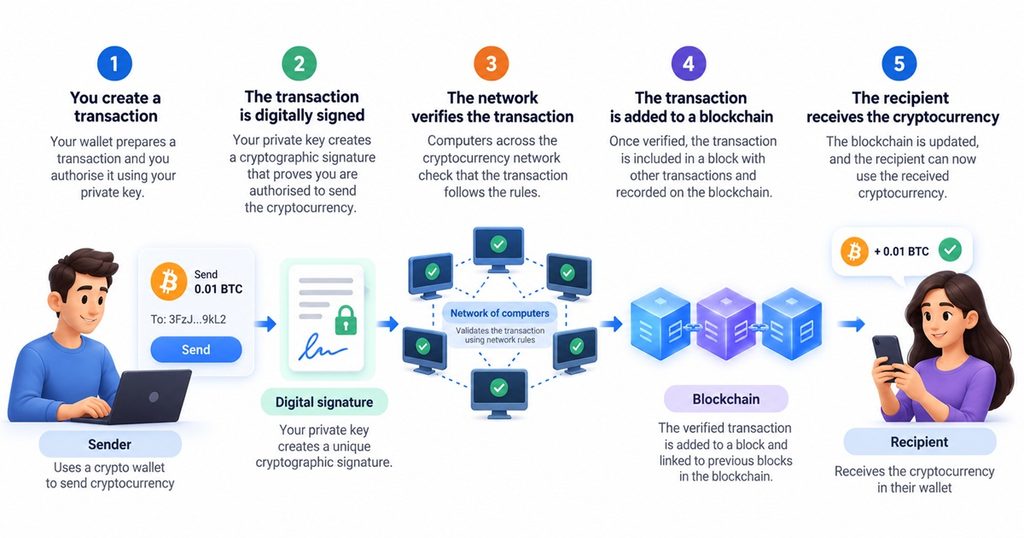
Cryptocurrency works by using a digital network to verify transactions, establish who can spend funds and maintain a shared record of transfers. Instead of asking a bank to approve every payment, many cryptocurrency networks use cryptography and a consensus mechanism to agree on valid transactions.
To understand how this works, imagine sending $100 worth of Bitcoin to a friend in another country.
The example below follows what happens behind the scenes, from pressing the Send button to the recipient receiving the Bitcoin.
Step 1: You Open Your Cryptocurrency Wallet
You open a Bitcoin wallet and enter your friend’s Bitcoin address, along with the amount you want to send.
Your wallet might show that you have $250 worth of Bitcoin available. However, this doesn’t mean $250 is physically stored inside your phone.
Your wallet manages the cryptographic keys needed to authorise spending Bitcoin recorded on the blockchain.
Think of your wallet as a tool for controlling your cryptocurrency, rather than a container holding digital coins.
The dollar value shown in your wallet is also an estimate based on Bitcoin’s current market price, which can change.
Step 2: Your Wallet Creates a Transaction
After entering the recipient’s address and amount, your wallet prepares a transaction.
For a typical Bitcoin payment, the transaction identifies previously received, unspent Bitcoin outputs that will fund the transfer.
It also specifies where the Bitcoin should go, including any change returned to an address controlled by your wallet.
For example, suppose your wallet controls an unspent output worth 0.002 BTC, and you want to send 0.001 BTC.
A simplified transaction might look like this:
| Transaction detail | Amount |
|---|---|
| Available Bitcoin output | 0.002 BTC |
| Bitcoin sent to your friend | 0.001 BTC |
| Network transaction fee | 0.00001 BTC |
| Change returned to your wallet | 0.00099 BTC |
These are illustrative Bitcoin amounts, not live exchange rates or fee estimates.
This reveals something many beginners don’t realise: Bitcoin transactions often work more like spending a banknote and receiving change than simply subtracting a number from a bank account.
Step 3: Your Wallet Signs the Transaction
Before the Bitcoin can be spent, your wallet uses the necessary private key to create a digital signature.
This signature provides cryptographic evidence that the transaction has been authorised under the spending conditions attached to the Bitcoin.
Your private key is not sent to the recipient or published on the blockchain.
Why does this matter?
Someone knowing your public Bitcoin address cannot spend your Bitcoin simply because they know the address.
However, someone who gains access to your private keys or recovery phrase may be able to steal your funds.
Step 4: The Transaction Is Sent to the Bitcoin Network
Once signed, your wallet broadcasts the transaction to the Bitcoin network, usually through a connected node or service.
Participating nodes check whether the transaction follows Bitcoin’s rules.
These checks include whether:
- The transaction has valid authorisation.
- The referenced Bitcoin outputs are available to spend.
- The transaction follows the network’s required format and consensus rules.
- The transaction does not attempt to create Bitcoin outside the permitted rules.
Valid transactions may then be held in a node’s memory pool, commonly called the mempool, while waiting for confirmation.
A transaction being broadcast does not mean it has already been permanently recorded in the blockchain.
For a deeper understanding of how cryptocurrency transactions are verified and recorded, the official Bitcoin documentation explains how the Bitcoin network processes payments, uses cryptographic signatures and maintains its blockchain.
Step 5: A Miner Includes the Transaction in a Block
Bitcoin miners compete to produce valid blocks using a process called proof of work.
A miner selects transactions, constructs a candidate block and performs computational work to find a block header hash that satisfies the network’s difficulty target.
When a valid block is found and accepted by the network, its transactions become part of the blockchain.
Miners are incentivised through newly issued Bitcoin, according to Bitcoin’s issuance schedule, and transaction fees.
Not all cryptocurrencies use mining. Some networks use proof-of-stake systems involving validators instead.
Step 6: Your Friend Receives the Bitcoin
Once the transaction is included in a valid block on the accepted Bitcoin chain, it has one confirmation.
As additional blocks are added, the transaction gains more confirmations, making it increasingly difficult to reverse through a blockchain reorganisation.
Your friend’s wallet can detect the incoming transaction and display the Bitcoin received.
Some wallets and services show incoming transactions before confirmation, while others require several confirmations before making funds available.
The important difference: Your friend doesn’t receive a digital coin file from your phone. The Bitcoin network’s records now include an output that can be spent using the appropriate cryptographic authorisation.
Step 7: What Actually Moved Between You and Your Friend?
Here’s the surprising part: no physical money travelled across the internet, and no Bitcoin file moved from one device to another.
Instead, three things happened:
- Your wallet created and authorised instructions to spend existing Bitcoin.
- The network checked those instructions against Bitcoin’s rules.
- The blockchain recorded new outputs representing who could spend the transferred value.
Your friend’s wallet can now use the relevant keys to authorise a future transaction.
That is the basic mechanism behind how Bitcoin cryptocurrency works.
What If You Send Cryptocurrency to the Wrong Address?
Unlike many traditional banking payments, a confirmed cryptocurrency transaction generally cannot be cancelled by contacting customer support.
If you send Bitcoin to the wrong valid address, recovery may depend on whether the recipient can be identified and is willing to return the funds.
Sending cryptocurrency through an incompatible network or to an unsupported address can also result in lost or inaccessible funds.
Before sending cryptocurrency, always verify the recipient’s address, selected network, amount and fees. For a significant transfer, consider sending a small test transaction first.
The Key Lesson
Cryptocurrency transfers are not simply numbers moving between two wallet screens.
They involve cryptographic authorisation, network verification and updates to a shared transaction record.
Understanding this process explains why cryptocurrency can operate without a bank processing every transfer, why network fees exist, why confirmations matter and why protecting your private keys is essential.
What Makes Cryptocurrency Different From Traditional Money?
The biggest difference between cryptocurrency and traditional money is how ownership, payments and transactions are controlled and recorded.
When you transfer money through a bank, the bank updates its records and processes the payment through the relevant financial systems. With a cryptocurrency such as Bitcoin, a decentralised network verifies transactions according to shared rules and records them on a blockchain.
However, cryptocurrency is not automatically faster, cheaper, safer or more private than traditional money. These differences depend on the cryptocurrency, network and payment method being used.
Cryptocurrency vs Traditional Money: Key Differences
| Feature | Cryptocurrency | Traditional money |
|---|---|---|
| Form | Digital assets | Physical cash and electronic balances |
| Issuance | Depends on the cryptocurrency’s rules | Generally managed through monetary and banking systems |
| Transaction verification | Blockchain networks or other digital systems | Banks and payment providers |
| Operating hours | Many networks operate 24/7 | Depends on the payment system |
| Transaction reversal | Confirmed blockchain transfers are generally difficult to reverse | Some payments may be disputed or reversed |
| Value | Often fluctuates significantly | Generally more stable in everyday purchasing power |
| Ownership control | Can be self-custodied or held through a provider | Cash can be held directly; bank deposits are claims against banks |
| Consumer protection | Varies and may be limited | Often includes established legal and regulatory protections |
Can Cryptocurrency Work Without a Bank?
Yes. Certain cryptocurrencies allow users to transfer funds directly between compatible wallets without needing a bank to authorise the transaction.
For example, two people using self-custody Bitcoin wallets can exchange Bitcoin even if neither has an account with a cryptocurrency exchange.
However, buying cryptocurrency with Australian dollars, converting it back into cash or paying everyday expenses may still involve exchanges, banks or payment services.
This distinction matters because using cryptocurrency without a bank is possible, but using cryptocurrency does not necessarily mean avoiding financial intermediaries.
Is Cryptocurrency the Same as Digital Money?
Not exactly.
Most money in modern bank accounts already exists electronically. When your employer deposits your salary, you normally receive an electronic bank balance rather than physical banknotes.
Cryptocurrency is also digital, but many cryptocurrencies use a different system for establishing ownership and transferring value.
Consider three examples:
- Bank deposit: Your bank maintains an account balance and owes you the deposited funds under the applicable terms and laws.
- Bitcoin: The network records spendable outputs, and the appropriate cryptographic keys allow you to authorise transactions.
- Stablecoin: A digital token designed to maintain a value relative to an asset, such as the US dollar, although its stability depends on its design, reserves and other risks.
Therefore, not all digital money is cryptocurrency, and not every cryptocurrency is intended to function as everyday money.
Who Controls Cryptocurrency?
There is no single answer because different cryptocurrencies operate under different governance and technical arrangements.
Bitcoin, for example, has no central administrator who can simply approve every payment or change everyone’s balances at will.
Its rules are enforced by participating nodes, while miners help produce blocks through proof of work. Changes to the network’s rules depend on software adoption and agreement among relevant participants.
Other cryptocurrency networks may have foundations, companies, developers or smaller groups of validators with greater influence over their operation.
A cryptocurrency being built on a blockchain does not automatically make it fully decentralised.
A Practical Example: What Happens If Your Bank or Crypto Exchange Goes Offline?
Imagine you have $1,000 in a bank account and another $1,000 worth of Bitcoin on a cryptocurrency exchange.
If your bank’s app temporarily stops working, you may be unable to access online banking, but your deposit remains a liability of the bank, subject to applicable laws and protections.
If your cryptocurrency exchange stops withdrawals, you may be unable to transfer your Bitcoin even if the Bitcoin network itself continues operating normally.
Now consider a third situation: you hold Bitcoin in a self-custody wallet and control your own recovery credentials.
If your wallet app becomes unavailable, you may be able to restore access using compatible wallet software and your recovery information, provided the relevant network remains operational.
This illustrates an important difference:
Owning cryptocurrency and having independent control over cryptocurrency are not always the same thing.
Self-custody can reduce dependence on an exchange, but it also makes you responsible for protecting your recovery credentials. Losing them without a backup can mean permanently losing access to your funds.
Does This Make Cryptocurrency Better Than Traditional Money?
Not necessarily. Each system has advantages and limitations.
Traditional banking offers familiar payment services, legal protections and generally stable account values in the local currency.
Cryptocurrency can provide alternative ways to transfer and hold digital assets, including self-custody and access to networks that operate internationally.
However, cryptocurrency users may face substantial price volatility, scams, transaction mistakes, network fees and limited options for recovering lost funds.
The more useful question is not whether cryptocurrency will replace traditional money, but which problems cryptocurrency can solve and which risks users must accept in exchange.
What Gives Cryptocurrency Its Value?
Cryptocurrency gets its market value from supply and demand, influenced by factors such as usefulness, scarcity, adoption, investor expectations and confidence in the network. Unlike traditional government-issued currencies, most cryptocurrencies are not backed by a central bank or guaranteed to maintain a particular value.
But why would someone pay thousands of dollars for something that exists only as digital records?
The answer becomes clearer when we separate what a cryptocurrency does, why people want it and what determines its market price.
1. Supply and Demand Determine the Price
Like many other assets, cryptocurrency prices are influenced by how much buyers are willing to pay and how much sellers are willing to accept.
Imagine a cryptocurrency with 1 million coins in circulation.
If more people want to buy those coins than existing holders are willing to sell at current prices, buyers may offer higher prices. If demand falls and more holders want to sell, the price may decline.
However, a limited supply does not automatically make a cryptocurrency valuable.
A digital coin could have a maximum supply of just 100 tokens and still be worth almost nothing if nobody wants to buy or use it.
Scarcity can influence value, but scarcity without demand does not create meaningful market value.
2. Why Does Bitcoin Have Value?
Bitcoin provides a useful example because its supply rules and transaction system are publicly documented.
Several characteristics contribute to demand for Bitcoin:
- Limited supply: Bitcoin’s protocol is designed to limit issuance to approximately 21 million BTC.
- Transferability: Bitcoin can be transferred across its network without requiring a bank to process the payment.
- Verifiability: Users can independently check transactions and the network’s monetary rules.
- Divisibility: One Bitcoin can be divided into 100 million units called satoshis.
- Network adoption: People, businesses and financial institutions may choose to hold or use Bitcoin.
These characteristics help explain why Bitcoin attracts demand, but they do not guarantee that its price will rise or remain stable.
Bitcoin’s market price still depends on what buyers and sellers are willing to exchange for it.
3. Why Are Some Cryptocurrencies Worth More Than Others?
Different cryptocurrencies offer different features, supply structures, levels of adoption and economic incentives.
For example, Bitcoin is primarily associated with transferring and holding value, while Ether (ETH) is used to pay for activity on the Ethereum network, including transactions involving smart contracts.
Some cryptocurrencies are designed for payments, others support blockchain applications, and some primarily attract speculative trading.
A cryptocurrency’s market price can reflect expectations about its future usefulness, but those expectations may never become reality.
A project can have advanced technology and still struggle to attract users. Another cryptocurrency may experience strong demand because of publicity or speculation, even if it offers limited practical functionality.
4. Does a Higher Coin Price Mean a Cryptocurrency Is More Valuable?
No. Comparing cryptocurrencies only by their individual coin prices can be misleading.
Consider two hypothetical cryptocurrencies:
| Feature | Crypto A | Crypto B |
|---|---|---|
| Price per coin | $100 | $0.01 |
| Circulating supply | 1 million | 10 billion |
| Market capitalisation | $100 million | $100 million |
Although Crypto A costs $100 per coin and Crypto B costs only one cent, both have the same market capitalisation.
Market capitalisation is calculated as:
Market capitalisation = Current coin price × Circulating supply
This calculation provides a more useful starting point for comparing the market sizes of cryptocurrencies.
However, market capitalisation does not represent the amount of money invested in a cryptocurrency, nor does it guarantee that all circulating coins could be sold at the current price.
5. A Less Obvious Example: Can a Cryptocurrency Be Worth $1 Million Without Anyone Investing $1 Million?
Imagine a new cryptocurrency with 1 million circulating coins.
Initially, a small number of coins trade at $0.10 each, giving the cryptocurrency an estimated market capitalisation of $100,000.
Later, buyers agree to purchase a small quantity at $1 per coin.
If $1 becomes the current market price, the estimated market capitalisation increases to $1 million.
Yet this does not mean buyers have deposited $1 million into the project.
The market capitalisation is calculated using the latest market price across the entire circulating supply, even though only a small portion of that supply may have traded recently.
This distinction explains why cryptocurrency prices can rise sharply in markets with limited liquidity.
It also explains why holders may struggle to sell large amounts at the displayed price.
A cryptocurrency’s quoted market value is not the same as the amount of cash available to purchase every coin.
6. Why Can Cryptocurrency Lose Its Value?
Cryptocurrency prices can fall when demand weakens, confidence disappears or market conditions change.
Possible causes include:
- Investors selling more cryptocurrency than buyers are willing to purchase at prevailing prices.
- Security breaches or technical problems affecting a project.
- Reduced demand for the cryptocurrency’s intended use.
- Large token holders selling significant quantities.
- Changes in regulations or access to trading platforms.
- Excessive token issuance or unexpected increases in circulating supply.
- Speculative enthusiasm fading after a period of rapid price growth.
Some cryptocurrencies have lost nearly all their market value, and others have become difficult or impossible to trade.
A cryptocurrency can continue operating technically while its market price declines substantially.
7. What Is the Difference Between Price, Value and Utility?
These three terms are related but should not be confused.
Price is what someone is currently willing to pay for a cryptocurrency in a particular market.
Utility refers to what the cryptocurrency can actually be used for, such as paying network fees, transferring value or interacting with blockchain applications.
Value is a broader assessment of what the asset is worth to its users or investors, based on its usefulness, characteristics, risks and expected future demand.
A cryptocurrency can have a rapidly rising price without a corresponding increase in practical utility.
Likewise, a cryptocurrency may provide a useful service without its token necessarily becoming a successful investment.
The Key Lesson: Technology Alone Does Not Create Financial Value
Understanding how cryptocurrency works explains how digital assets can be transferred and verified without a traditional banking intermediary.
Understanding what gives cryptocurrency value requires another question: Why would someone want to own or use this particular digital asset?
The answer may involve practical usefulness, scarcity, adoption, expectations or speculation.
For beginners, recognising the difference between a functioning cryptocurrency network and a financially valuable cryptocurrency is essential. A technology can work exactly as designed while its associated cryptocurrency loses most or all of its market value.
What Are the Different Types of Cryptocurrency?
Not all cryptocurrencies work the same way or serve the same purpose. Some are designed to transfer value between people, others power blockchain networks, and some are created to maintain a relatively stable price.
Understanding these differences helps beginners recognise what they are actually buying, holding or transferring.
1. Bitcoin (BTC): A Cryptocurrency for Transferring and Holding Value
Bitcoin was introduced in 2009 as a peer-to-peer electronic cash system. It allows users to transfer Bitcoin across a decentralised network without requiring a bank to process each transaction.
Bitcoin has a predefined issuance schedule and a maximum supply of approximately 21 million BTC.
Although Bitcoin was originally designed as a payment system, many holders now also view it as a long-term investment or speculative store of value.
However, Bitcoin’s price can fluctuate significantly, making it less predictable than traditional currencies for everyday purchases.
2. Ether (ETH): Cryptocurrency Used by the Ethereum Network
Ether is the native cryptocurrency of Ethereum, a blockchain network that supports programmable transactions through smart contracts.
Unlike Bitcoin, which primarily focuses on transferring and recording value, Ethereum also allows developers to build applications that operate using blockchain technology.
For example, ETH can be used to pay transaction fees when someone interacts with an application on Ethereum.
ETH is also used in Ethereum’s proof-of-stake system, where validators stake ETH to participate in securing the network.
This illustrates an important distinction: some cryptocurrencies are used not only to transfer value but also to operate the networks on which they exist.
3. Stablecoins: Cryptocurrencies Designed to Maintain a Stable Price
Stablecoins are digital tokens designed to maintain a value relative to another asset, commonly the US dollar.
For example, USDC and USDT are designed to trade close to one US dollar per token.
Stablecoins can be useful when someone wants to transfer digital value without being exposed to the same level of price volatility as Bitcoin or Ether.
However, stablecoins are not risk-free. Their stability depends on factors such as reserves, redemption arrangements, issuer reliability, market liquidity and technical security.
Some stablecoins have lost their intended price peg, and holding a stablecoin is not necessarily equivalent to holding money in an insured bank account.
4. Utility Tokens: Digital Assets Used Within Applications
Some cryptocurrencies or crypto tokens are designed to provide access to services, pay fees or perform functions within a particular blockchain ecosystem.
For example, a token might be required to pay for network resources, participate in an application or access certain features.
However, having a stated utility does not automatically make a token valuable.
Its economic value still depends on factors such as genuine demand, token supply, market liquidity and how the token is actually used.
5. Meme Coins: Cryptocurrencies Driven Largely by Community Interest
Meme coins are cryptocurrencies often associated with internet culture, humour or online communities.
Dogecoin (DOGE) is a well-known example.
Some meme coins develop payment functionality or broader ecosystems, but many rely heavily on community attention and speculative demand.
Their prices can change rapidly, and projects with limited liquidity or concentrated ownership may expose buyers to substantial losses.
What Is the Difference Between a Cryptocurrency Coin and a Token?
The words coin and token are often used interchangeably, but they can describe different types of crypto assets.
A coin generally refers to the native asset of a blockchain, such as BTC on Bitcoin or ETH on Ethereum.
A token is usually an asset created using an existing blockchain’s infrastructure, such as an ERC-20 token issued on Ethereum.
| Cryptocurrency coin | Crypto token |
|---|---|
| Usually native to its own blockchain | Usually issued on an existing blockchain |
| May be used for network fees or security | May represent utility, governance rights or other functions |
| Examples: BTC, ETH | Examples: USDC on Ethereum, UNI |
This distinction matters when transferring cryptocurrency because different assets can operate on different networks.
For example, a token may exist on multiple blockchain networks. Selecting the wrong network when sending funds to an exchange or wallet can result in funds becoming inaccessible.
Which Type of Cryptocurrency Is Best for Beginners?
There is no single cryptocurrency that is automatically suitable for every beginner.
The more useful starting point is understanding what each asset is designed to do, how its network operates, what controls its supply and which risks apply.
Before using a cryptocurrency, beginners should be able to answer three questions:
- What is this cryptocurrency used for?
- Which network does it operate on?
- What could cause me to lose access to it or lose money?
Knowing these answers is more valuable than choosing a cryptocurrency simply because its individual coin price looks inexpensive.
How Do You Own and Store Cryptocurrency?
Owning cryptocurrency is different from keeping cash in a wallet or money in a bank account. Cryptocurrency generally remains recorded on its blockchain, while a crypto wallet manages the cryptographic keys needed to authorise transactions.
This means your cryptocurrency is not physically stored inside your phone, computer or hardware wallet. What matters is who has the ability to control and transfer it.
What Does It Actually Mean to Own Cryptocurrency?
Imagine you purchase $200 worth of Bitcoin.
You might see a Bitcoin balance displayed inside an exchange account or a cryptocurrency wallet. However, that balance alone does not explain how your Bitcoin is held.
There are two common arrangements:
- Custodial ownership: A cryptocurrency exchange or another provider controls the private keys and maintains records of your entitlement to cryptocurrency.
- Self-custody: You control the private keys or recovery credentials needed to authorise transactions directly.
Both arrangements allow people to gain exposure to cryptocurrency, but they involve different responsibilities and risks.
Cryptocurrency on an Exchange vs in Your Own Wallet
Suppose two people each purchase $500 worth of Bitcoin.
Person A keeps Bitcoin on a cryptocurrency exchange.
The exchange generally controls the relevant private keys and records the customer’s balance within its own system. When Person A requests a withdrawal, the exchange must process it.
If the exchange freezes withdrawals, suffers a security breach or becomes insolvent, Person A may have difficulty recovering their cryptocurrency.
Person B transfers Bitcoin to a self-custody wallet.
Person B controls the credentials needed to authorise transactions. They can generally use compatible wallet software to access their Bitcoin without depending on the original wallet provider.
However, if Person B loses the recovery credentials and has no usable backup, they may permanently lose access.
The difference is not simply where cryptocurrency is displayed. It is who controls the credentials required to move it.
What Happens If Your Crypto Wallet App Disappears?
Consider a situation where you install a cryptocurrency wallet, receive Bitcoin and later discover that the wallet application is no longer available.
Does that mean your Bitcoin has disappeared?
Not necessarily.
If you have the correct recovery information and the wallet uses a compatible recovery standard, you may be able to restore access through another wallet application.
Your Bitcoin remains represented on the blockchain. The wallet application is simply one way of managing the credentials needed to use it.
However, recovery depends on the wallet’s design, the type of credentials involved and whether compatible software is available.
This is why securely backing up recovery information matters more than simply remembering which wallet application you installed.
What Is a Private Key and Why Is It Important?
A private key is a secret cryptographic value used to produce digital signatures that authorise cryptocurrency transactions.
A public address, by contrast, can generally be shared with someone who wants to send you cryptocurrency.
The difference is similar to providing someone with details needed to receive a payment versus giving them the credentials needed to authorise spending.
A wallet recovery phrase commonly provides a way to regenerate multiple private keys, depending on the wallet’s design.
Anyone who obtains the necessary private keys or recovery credentials may be able to transfer the associated cryptocurrency without your permission.
Never share your private keys or recovery phrase with anyone claiming to provide wallet support, verify your account or release a cryptocurrency payment.
Can You Lose Cryptocurrency Even If the Blockchain Is Working?
Yes. A cryptocurrency network can continue operating normally while an individual loses access to their funds.
For example:
| Situation | Possible outcome |
|---|---|
| You forget an exchange password | Account recovery may be available |
| You lose your phone with a wallet installed | Funds may be recoverable using a valid backup |
| You lose your recovery phrase and access to your wallet | Funds may become permanently inaccessible |
| Someone steals your private keys | They may be able to transfer your cryptocurrency |
| An exchange suspends withdrawals | You may temporarily or permanently lose access |
| You send funds to an incorrect address | Recovery may be impossible without the recipient’s cooperation |
These examples reveal an important feature of cryptocurrency: a functioning network does not guarantee that every user can recover lost funds or reverse mistakes.
The Key Lesson: Ownership and Control Are Not Always the Same
When someone says they own cryptocurrency, it is worth asking whether they personally control the necessary private keys or depend on another organisation to hold the assets.
Self-custody provides greater independence but also places greater responsibility on the user. Custodial services may offer convenience and account recovery options, but introduce dependence on the provider.
Understanding this distinction is essential to understanding how cryptocurrency works in everyday use.
How Is New Cryptocurrency Created?
New cryptocurrency is created according to the rules of its network or token system. Depending on the cryptocurrency, new units may enter circulation through mining, protocol-controlled issuance, token creation or other predefined mechanisms.
Unlike traditional money, where central banks and commercial banking systems play important roles in monetary creation, many cryptocurrencies have issuance rules that can be examined publicly. Unlike Bitcoin miners, proof-of-stake networks use validators to help verify transactions and secure the blockchain. Learn more about how crypto validators work and the role they play in maintaining blockchain networks.
However, not every cryptocurrency is mined, and not every cryptocurrency has a fixed supply.
1. Cryptocurrency Mining: How Bitcoin Enters Circulation
Bitcoin uses a process called proof of work, commonly known as cryptocurrency mining.
Miners operate specialised computers that compete to produce valid blocks of transactions. To do this, they repeatedly calculate cryptographic hashes until they find a result that meets the network’s difficulty target.
When a miner successfully produces a block that the network accepts, the miner can receive newly issued Bitcoin through the block reward, along with transaction fees.
The newly issued Bitcoin is called the block subsidy.
Bitcoin’s subsidy is reduced approximately every four years through an event known as the Bitcoin halving.
For example, the subsidy decreased from 6.25 BTC to 3.125 BTC per block in April 2024.
Mining therefore performs two important functions: it helps secure Bitcoin’s transaction history and provides a controlled mechanism for introducing new Bitcoin into circulation.
2. Proof of Stake: How Some Networks Operate Without Mining
Not all cryptocurrencies use energy-intensive mining.
Ethereum, for example, uses a consensus mechanism called proof of stake.
Instead of competing through computational work, validators commit cryptocurrency as stake and participate in proposing and verifying blocks according to the network’s rules.
Validators may receive rewards for performing their duties correctly and can face penalties for certain failures or dishonest behaviour.
On Ethereum, validator rewards can contribute to new ETH issuance, while transaction fee burning can reduce the existing supply.
This means staking rewards and the creation of new cryptocurrency are related in some networks, but they are not always the same thing.
Some staking rewards may come from transaction fees, existing reward allocations or other sources rather than newly created coins.
Some proof-of-stake networks allow cryptocurrency holders to participate in staking, either directly or through supported services. Our guide to what crypto staking means and how it works explains the process, rewards and risks in more detail.
3. Can Someone Create a Cryptocurrency Without Mining?
Yes. A cryptocurrency token can be created using an existing blockchain that supports token issuance.
For example, developers can deploy smart contracts on compatible networks to create tokens with defined supply rules and transfer functions.
A project might create 10 million tokens at launch, release additional tokens over time or use a contract that permits further issuance.
However, creating a token does not automatically give it market value, users, liquidity or a functioning business model.
The ability to create cryptocurrency is different from building a cryptocurrency that people have a genuine reason to use.
4. Who Decides How Many Cryptocurrency Coins Exist?
The answer depends on the cryptocurrency’s design and governance.
| Cryptocurrency example | How supply works |
|---|---|
| Bitcoin (BTC) | Issuance follows protocol rules, with an approximate 21 million BTC maximum |
| Ether (ETH) | Supply changes through protocol issuance and fee burning, without a fixed maximum |
| Fixed-supply token | A defined number of tokens may be created, with no additional minting permitted |
| Mintable token | Additional tokens may be issued if authorised by its smart contract rules |
For tokens, it is important to understand whether an administrator or contract mechanism can create additional supply.
A token advertised as having a limited supply may still involve other risks, including concentrated ownership, unlocked allocations or smart contract vulnerabilities.
5. A Practical Example: Does Creating More Cryptocurrency Make Everyone Richer?
Imagine a cryptocurrency project has 1 million circulating tokens, each trading at $1.
Its estimated market capitalisation is $1 million.
Now suppose the project creates another 1 million tokens.
There are 2 million tokens, but that does not automatically mean the project has doubled in economic value.
If demand does not increase alongside supply, the additional tokens may place downward pressure on the market price.
The outcome depends on factors such as demand, distribution, liquidity and whether the new tokens enter active circulation.
Creating more cryptocurrency increases the number of units, not necessarily the total value of the network.
The Key Lesson
Cryptocurrency creation follows different mechanisms depending on the asset.
Bitcoin uses mining and a declining issuance schedule. Ethereum uses proof of stake with protocol-controlled issuance and fee burning. Other digital tokens may be created through smart contracts with their own supply rules.
Understanding how new units enter circulation helps explain cryptocurrency scarcity, network incentives and why two digital assets can have very different economic characteristics.
How Do People Buy, Sell and Use Cryptocurrency?
People can buy, sell and use cryptocurrency through crypto exchanges, compatible digital wallets and services that accept digital assets. Although cryptocurrency operates differently from traditional money, using it often begins with familiar actions such as creating an account, making a purchase or sending a payment.
The important difference is what happens after the purchase: you may hold cryptocurrency through a service provider or transfer it to a wallet you control.
How Do You Buy Cryptocurrency for the First Time?
Imagine someone in Australia wants to purchase $100 worth of Bitcoin.
A typical process involves:
- Choosing a cryptocurrency exchange: The person selects a platform that supports Bitcoin purchases and Australian dollar deposits.
- Creating an account: The exchange may require identity verification under applicable regulations.
- Depositing funds: The person transfers Australian dollars using an available payment method.
- Purchasing Bitcoin: The exchange executes the purchase at an available market price, subject to fees and spreads.
- Deciding where to hold it: The buyer can leave the Bitcoin with the exchange or, if withdrawals are supported, transfer it to a compatible self-custody wallet.
For example, if Bitcoin were trading at A$100,000 per BTC, a A$100 purchase would represent approximately 0.001 BTC before fees.
The buyer does not need to purchase an entire Bitcoin because Bitcoin is divisible into smaller units.
The displayed market price, trading fees and withdrawal costs can affect how much cryptocurrency the buyer ultimately receives. If you’re new to digital assets, understanding how cryptocurrency works is only the first step.
Our beginner’s guide to buying cryptocurrency explains the practical steps involved in making your first purchase, including choosing a platform and understanding transaction fees.
How Do You Sell Cryptocurrency?
Selling cryptocurrency generally involves exchanging a digital asset for another cryptocurrency or a traditional currency such as the Australian dollar.
For example, someone holding Bitcoin might sell part of their balance through an exchange and withdraw the proceeds to a linked bank account.
The amount received depends on the execution price, trading fees, spreads and any withdrawal charges.
Importantly, the price shown on a trading screen is not a guarantee that a large order can be completed entirely at that price.
In markets with limited liquidity, selling a significant quantity may move the price or result in a less favourable average execution price.
Can You Use Cryptocurrency to Pay for Things?
Yes, provided the recipient accepts the cryptocurrency and the payment method is compatible.
For example, a business might accept Bitcoin directly through a wallet or use a payment processor that converts the cryptocurrency into traditional currency.
However, cryptocurrency is not universally accepted, and some networks may be impractical for small purchases when transaction fees are high.
A cryptocurrency payment can also create additional considerations, including exchange-rate changes, transaction confirmation times, refunds and tax obligations.
What Happens When You Pay $50 Using Cryptocurrency?
Imagine a business advertises a product for A$50 and agrees to accept Bitcoin.
At checkout, the payment service calculates the Bitcoin amount based on an applicable exchange rate.
You authorise the transfer from your wallet, and the transaction is submitted to the network.
The business or payment processor then determines when the payment has been sufficiently confirmed.
There are two possible arrangements:
- The business receives and keeps Bitcoin.
- A payment processor receives the Bitcoin and converts the proceeds into traditional currency for the business.
In both cases, cryptocurrency is used to facilitate the payment, but the business does not necessarily hold cryptocurrency after the transaction.
This is one reason cryptocurrency payments and cryptocurrency investments should not be treated as the same activity.
Do You Need to Buy Cryptocurrency to Understand or Use Blockchain Technology?
No. You can learn how cryptocurrency transactions work by exploring public blockchain records, reading network documentation or using educational test networks where available.
Some blockchain applications require their native cryptocurrency to pay transaction fees, while others use services that handle certain technical requirements on behalf of users.
For beginners, understanding how transactions are authorised, verified and recorded is more important than immediately purchasing digital assets.
Is Buying Cryptocurrency the Same as Investing in a Company?
No. Purchasing cryptocurrency does not normally give you ownership of the company or organisation associated with a project.
For example, buying Bitcoin does not provide shares in a company called Bitcoin, and holding Ether does not automatically give you ownership of the Ethereum Foundation.
A cryptocurrency’s rights and functions depend on its design and any applicable legal arrangements.
This distinction is particularly important when evaluating projects that advertise future developments, business partnerships or investment opportunities.
What Should Beginners Check Before Using Cryptocurrency?
Before making a cryptocurrency transaction, it helps to understand:
- The asset: Which cryptocurrency are you buying or sending?
- The network: Which blockchain or transfer network does it use?
- The fees: What are the trading, network and withdrawal costs?
- The custody arrangement: Who controls the private keys?
- The recipient: Is the destination address correct and compatible?
- The risks: Could you lose money through volatility, fraud or a transaction mistake?
For Australian users, buying, selling, swapping or spending cryptocurrency may also have tax consequences depending on the circumstances.
The Australian Taxation Office provides guidance on the tax treatment of crypto assets.
The Key Lesson
Buying cryptocurrency is often straightforward, but understanding what happens after the purchase is more important.
A balance displayed on an exchange, cryptocurrency held in a self-custody wallet and a payment made through a crypto processor can involve very different arrangements.
Knowing how these systems work helps beginners make more informed decisions and avoid mistakes that may be difficult or impossible to reverse.
What Are the Risks and Limitations of Cryptocurrency?
Cryptocurrency allows people to transfer and control digital assets in ways that can differ from traditional banking. However, the same features that make cryptocurrency useful can also introduce risks, including price volatility, irreversible transactions, scams, lost access and technical vulnerabilities.
Understanding how cryptocurrency works means recognising not only what the technology can do, but also where its protections end.
1. Cryptocurrency Prices Can Change Rapidly
The value of many cryptocurrencies can rise or fall significantly within a short period.
For example, imagine purchasing A$1,000 worth of cryptocurrency. If its market price falls by 40%, your holdings would be worth approximately A$600, assuming no additional transactions or fees.
Even cryptocurrencies with active networks and large communities can experience substantial price declines.
A functioning blockchain does not guarantee that its cryptocurrency will maintain its market value.
2. Cryptocurrency Transactions Are Usually Difficult to Reverse
When you send money through a bank, certain mistakes or fraudulent transactions may be investigated through established banking procedures.
With cryptocurrency, a confirmed blockchain transaction generally cannot be cancelled simply by contacting a bank, wallet developer or network participant.
If you send cryptocurrency to an incorrect but valid address, the funds may be permanently lost unless the recipient can and agrees to return them.
This makes checking addresses and network compatibility particularly important.
3. Losing Your Private Keys Can Mean Losing Your Funds
A self-custody cryptocurrency wallet gives users direct control over the credentials needed to authorise transactions.
However, this also creates personal responsibility.
If you lose access to your wallet and have no usable recovery information, there may be no central administrator capable of restoring your funds.
Likewise, anyone who obtains your private keys or recovery phrase may be able to transfer your cryptocurrency without permission.
A useful security rule: Never enter your wallet recovery phrase into a website, form or application merely because someone claims it is required to verify your wallet or receive a payment.
4. Cryptocurrency Scams Can Look Like Legitimate Opportunities
Cryptocurrency scams can involve fake investment platforms, impersonated support representatives, fraudulent token projects and misleading promises of guaranteed returns.
For example, a website might display a growing cryptocurrency balance while preventing users from withdrawing funds unless they pay additional fees.
The balance shown on the website may not represent cryptocurrency genuinely held on the user’s behalf.
A common warning sign is a promise of high returns with little or no risk.
Cryptocurrency transactions being recorded on a public blockchain does not automatically make every company, token or investment opportunity trustworthy.
5. Blockchain Security Does Not Mean Every Crypto Application Is Secure
A cryptocurrency network may operate reliably while services built around it experience security failures.
For example, a blockchain can continue processing transactions even if a cryptocurrency exchange is hacked.
Other risks can arise from wallet software, smart contracts, malicious browser extensions, compromised devices or fraudulent websites.
This distinction is important because the security of a blockchain and the security of an application using that blockchain are not the same thing.
6. Transaction Fees and Network Congestion Can Affect Payments
Cryptocurrency transactions are not always instant or inexpensive.
When a network becomes busy, users may need to pay higher transaction fees to encourage faster inclusion in a block.
Some networks also have limited transaction capacity, meaning transfers can take longer during periods of heavy demand.
The cost and speed of a cryptocurrency payment depend on the network, transaction conditions and any additional services involved.
7. Cryptocurrency Is Not Always Anonymous
A common misunderstanding is that cryptocurrency transactions are automatically private or anonymous.
On public blockchains such as Bitcoin and Ethereum, transaction information is generally visible to anyone using a blockchain explorer.
Although wallet addresses do not necessarily display a person’s legal name, transactions may sometimes be connected to individuals through exchange records, public disclosures or blockchain analysis.
Cryptocurrency can therefore provide different levels of privacy depending on the network and how it is used, but users should not assume their activity is untraceable.
8. Decentralisation Does Not Eliminate Every Form of Control
Some cryptocurrency networks distribute control among many participants, but others depend heavily on developers, administrators, large token holders or a limited group of validators.
For example, a token may operate on a public blockchain while its smart contract still allows an administrator to mint additional tokens or restrict certain transfers.
The underlying blockchain may be decentralised, but the token itself can retain centralised features.
This is why understanding who can change a cryptocurrency’s rules is just as important as understanding how transactions are processed.
Cryptocurrency risks also extend to activities such as staking, where users may face validator penalties, smart contract vulnerabilities or restrictions on accessing funds. If you’re considering staking, understand whether you can lose cryptocurrency when staking before participating.
A Practical Cryptocurrency Risk Checklist
| Before you… | Check this first |
|---|---|
| Buy cryptocurrency | Understand the asset, price volatility and fees |
| Send cryptocurrency | Verify the address, asset and network |
| Use a new wallet | Understand how recovery credentials work |
| Hold funds on an exchange | Review custody arrangements and withdrawal conditions |
| Connect to a crypto application | Check the website, permissions and potential smart contract risks |
| Consider a crypto investment | Be cautious of guaranteed returns and pressure to act quickly |
The Key Lesson
Cryptocurrency can provide direct control over digital assets and access to payment networks that operate without traditional banking intermediaries.
But these benefits come with responsibilities that many people are unfamiliar with when first using cryptocurrency.
The most important principle is simple: understand who controls your cryptocurrency, how transactions are authorised and what options exist if something goes wrong.
Learning these fundamentals before transferring significant amounts can help prevent avoidable mistakes.
Conclusion: Understanding How Cryptocurrency Really Works
Cryptocurrency is more than digital money displayed inside an application. It is a system for recording, verifying and transferring digital assets using cryptography and network rules.
As the examples in this guide demonstrate, sending cryptocurrency involves more than pressing a button. A transaction must be authorised, checked by the network and recorded according to the cryptocurrency’s underlying technology.
The most important things to understand are how transactions work, who controls the private keys, how new cryptocurrency enters circulation and what determines its market value.
Cryptocurrency can offer new ways to transfer and control digital assets, but it also introduces risks that differ from traditional banking.
For anyone learning about crypto for the first time, understanding these fundamentals is a better starting point than trying to predict which cryptocurrency will increase in price.
Frequently Asked Questions About Cryptocurrency
What Exactly Is Cryptocurrency and How Does It Work?
Cryptocurrency is a digital asset that uses cryptography to secure transactions. Many cryptocurrencies operate on blockchain networks, where computers verify transactions and maintain shared records of ownership and transfers. This allows users to send digital value without requiring a bank to process every transaction.
What Is Cryptocurrency and How Does It Work for Beginners?
For beginners, cryptocurrency works through three basic steps: a wallet creates and authorises a transaction, a network checks whether it follows the rules, and the transaction is recorded on a blockchain or another supported ledger. The recipient can then use the received cryptocurrency according to the network’s rules.
Is Cryptocurrency Real Money or Just Digital Numbers?
Cryptocurrency exists digitally, but that does not mean it is imaginary. Bitcoin and other cryptocurrencies can be transferred, exchanged and used for payments where accepted. However, most cryptocurrencies are not legal tender, and their market values can change significantly.
How Does Cryptocurrency Work Without a Bank?
Many cryptocurrencies use decentralised networks instead of relying on a bank to maintain the primary transaction ledger. Network participants verify transactions using agreed rules and cryptographic methods. However, cryptocurrency exchanges and payment services may still act as intermediaries when people buy, sell or use digital assets.
What Is Blockchain and How Does It Work in Cryptocurrency?
A blockchain is a digital ledger that records information in linked blocks. In cryptocurrencies such as Bitcoin, blocks contain transaction records, and the network uses a consensus mechanism to agree on the accepted transaction history. This helps participants verify transfers and makes changing established records increasingly difficult.
Can You Explain Cryptocurrency With a Simple Example?
Imagine you send Bitcoin to a friend. Your wallet signs a transaction using the necessary private key, and the Bitcoin network checks whether the transaction is valid. Once the transaction is included in an accepted block, the blockchain records the transfer, allowing your friend to spend the received Bitcoin.
Is Bitcoin the Same as Cryptocurrency?
No. Bitcoin is one cryptocurrency, while cryptocurrency is the broader category of digital assets that use cryptographic technology. Other examples include Ether, Litecoin and Dogecoin. Different cryptocurrencies can have different purposes, supply rules and methods for verifying transactions.
Do You Need a Crypto Wallet to Use Cryptocurrency?
You need a way to manage or access cryptocurrency, but you do not always need a separate self-custody wallet. Cryptocurrency exchanges may provide custodial accounts that hold assets on your behalf. A self-custody wallet gives you direct control over the credentials used to authorise transactions.
Can Cryptocurrency Be Converted Into Real Money?
Yes. Many cryptocurrencies can be exchanged for traditional currencies, including Australian dollars, through supported exchanges or other services. The amount received depends on the market price, available liquidity, fees and the service used.
Can Cryptocurrency Work Without the Internet?
Most cryptocurrency transactions require network connectivity to be broadcast and confirmed. Some wallets can create and sign transactions offline, but those transactions generally need to reach the relevant network before they can be processed. Offline signing does not mean the blockchain itself operates without connected participants.
Is Cryptocurrency Safe for Beginners?
Cryptocurrency networks can use strong cryptographic security, but using cryptocurrency still involves risks. Beginners may lose money through price changes, scams, compromised wallets, exchange failures or sending funds incorrectly. Understanding wallet security, transaction verification and custody arrangements is important before using cryptocurrency.
Can You Lose More Money Than You Put Into Cryptocurrency?
When purchasing cryptocurrency directly without borrowing or leverage, your loss is generally limited to the amount spent on the asset, plus associated costs. However, leveraged trading, borrowing and certain cryptocurrency financial products can create additional liabilities.
Does Cryptocurrency Have a Future?
Cryptocurrency technology continues to be developed for payments, digital asset transfers and blockchain-based applications. However, the long-term adoption and value of individual cryptocurrencies remain uncertain. Technological development does not guarantee investment returns or widespread acceptance.