The best crypto for staking isn’t necessarily the coin offering the highest advertised reward. A high staking rate can look attractive, but the actual outcome also depends on token inflation, price movements, withdrawal or unstaking rules, validator risks, fees and how the rewards are generated.
Major Proof-of-Stake cryptocurrencies such as Ethereum, Solana and Cardano offer different ways to participate in staking. Depending on the network, participation may involve running a validator, delegating tokens to a validator or stake pool, or using a third-party staking service or pool.
That means comparing the best staking coins requires more than putting their advertised reward rates side by side. This guide looks at factors that can materially affect staking, including rewards, inflation, liquidity, slashing and penalty risks, custody, accessibility and the underlying network.
The goal is to help you understand what makes a cryptocurrency suitable for staking and how to compare the best crypto to stake without assuming that the highest percentage automatically means the best opportunity.
If you’re new to staking itself, start with our guide explaining what crypto staking is and how it works before comparing individual staking coins.
What Is the Best Crypto for Staking?
There is no single cryptocurrency that is automatically the best to stake for everyone. The right choice depends on whether you value higher potential rewards, easy access to your coins, lower technical complexity, an established network, or reduced exposure to staking penalties.
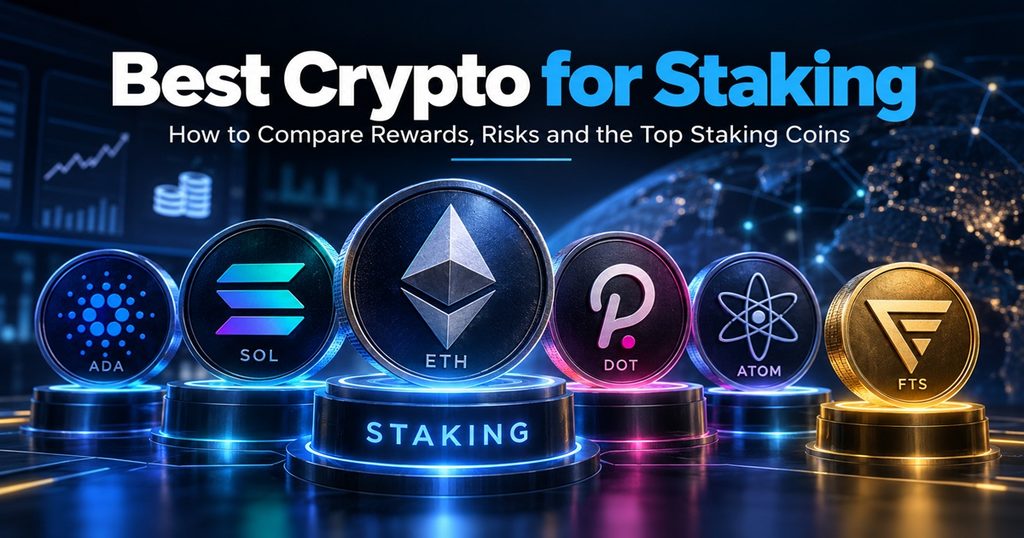
Among major Proof-of-Stake networks, Ethereum, Solana and Cardano are three important cryptocurrencies to compare for staking, but their staking systems work differently.
| Cryptocurrency | How holders can participate | Important consideration |
|---|---|---|
| Ethereum (ETH) | Solo validation, staking services or pooled staking | Running your own validator requires ETH and technical infrastructure; penalties and slashing can apply |
| Solana (SOL) | SOL can be delegated to validators | Rewards vary with factors including network inflation, active stake, validator performance and commission |
| Cardano (ADA) | ADA can be delegated to stake pools | Native delegation is non-custodial, has no lock-up and ADA remains spendable |
| Polkadot (DOT) | DOT holders can participate through Polkadot’s staking system | Staking mechanics, participation requirements and rewards should be checked before committing DOT |
| Cosmos Hub (ATOM) | ATOM can be delegated to validators | Validator choice and network-specific staking risks need to be considered |
Which Staking Coin Is Best?
For someone comparing the best crypto to stake, a useful starting point is not simply asking which coin has the highest APY. Instead, compare:
- How staking rewards are generated
- Current reward rate and whether it changes
- Token inflation and its effect on real returns
- Lock-up, bonding or unstaking periods
- Slashing and other penalty risks
- Whether staking remains non-custodial
- Validator or staking-pool fees
- Liquidity and ability to exit
- The underlying cryptocurrency’s price risk
A staking coin offering a 12% nominal reward is not automatically better than one offering 4%. If the first token experiences substantially higher inflation, greater price losses, restrictive unstaking conditions or additional risk, its higher staking rate may not translate into a better outcome.
The best staking crypto should therefore be judged on the quality and risks of the entire staking arrangement—not APY alone.
How We Compare the Best Staking Coins
Comparing the best coins for staking requires looking beyond the headline reward rate. Staking systems differ between blockchains, and a higher advertised percentage can come with different inflation, withdrawal conditions, validator requirements and risks.
For this guide, we consider the following factors.
1. Staking Reward Structure
We look at how staking rewards are generated and distributed rather than simply ranking cryptocurrencies by the highest displayed APY or APR.
Reward rates can change as network conditions change. Depending on the blockchain, factors such as the amount of cryptocurrency being staked, protocol issuance, validator performance and fees can affect what participants receive.
2. Token Inflation
A high nominal staking reward does not necessarily mean an equally high increase in purchasing power.
If staking rewards are partly funded through new token issuance, growth in the token supply can dilute holders. This makes inflation an important part of comparing high staking rewards between cryptocurrencies.
3. Lock-Up and Unstaking Conditions
We consider how easily staked cryptocurrency can become available again.
Some networks allow relatively flexible delegation, while others use activation queues, unbonding periods or withdrawal processes. These rules matter because market conditions can change while assets are waiting to become transferable.
4. Slashing and Validator Risk
Staking can involve protocol-specific penalties.
On networks that use slashing, certain validator actions can result in a loss of stake. Even where delegators do not operate validators themselves, understanding how the chosen network handles validator performance and penalties is important.
5. Custody
We distinguish between native staking and arrangements that require a third party or smart contract.
If you maintain control of your keys while delegating through the blockchain’s native staking mechanism, the custody arrangement is different from depositing cryptocurrency with a centralised platform.
6. Accessibility
The best staking option also needs to be practical.
We consider factors such as minimum requirements, whether a validator must be operated, whether delegation is supported, technical complexity and how easily an ordinary token holder can participate.
7. Liquidity
Staking rewards should not be considered separately from the ability to access or sell the underlying asset.
We therefore consider withdrawal restrictions and other conditions that may affect how quickly a participant can regain access to staked cryptocurrency.
8. Underlying Token Risk
Staking does not remove cryptocurrency price risk.
For example, earning a 7% staking reward would not compensate for a 40% fall in the market value of the underlying token. Conversely, a lower staking rate does not automatically make a cryptocurrency a worse staking option.
For that reason, this guide does not label a cryptocurrency the best crypto for staking solely because it currently advertises the highest reward.
Our comparison principle: A good staking opportunity combines a sustainable reward structure with reasonable access, understandable risks and a staking mechanism that suits the holder—not simply the highest APY.
Ethereum (ETH) Staking
Ethereum is one of the most established cryptocurrencies offering Proof-of-Stake participation. ETH holders can stake directly by operating a validator or use third-party and pooled staking options if they do not want to run validator infrastructure themselves.
How Ethereum Staking Works
Running your own Ethereum validator requires a minimum of 32 ETH, suitable hardware, an internet connection and ongoing validator maintenance. Ethereum also supports compounding validators, which can have an effective balance of up to 2,048 ETH.
People with less than 32 ETH can still gain exposure to Ethereum staking through staking pools and other third-party arrangements, although these introduce additional considerations such as smart-contract, operator or custody risk depending on the method used.
Ethereum does not provide native stake delegation at the protocol level in the same way as some other Proof-of-Stake networks. Services offering delegated, pooled or liquid ETH staking add another layer between the holder and Ethereum’s underlying staking protocol.
Ethereum provides detailed information about validator requirements, staking options, rewards and associated risks in its official Ethereum staking documentation.
Ethereum Staking Rewards
Ethereum’s staking reward rate is variable rather than fixed. The amount validators can earn changes with network conditions, including the amount of ETH participating in staking.
For that reason, a current Ethereum staking rate should be treated as a snapshot rather than a guaranteed long-term return.
Validators can receive consensus-layer rewards for correctly performing duties such as attestations and block proposals. Block proposers may also receive execution-layer rewards such as priority fees and MEV.
Ethereum Staking Risks
ETH staking is not risk-free.
Validators that fail to perform their duties can lose potential rewards and incur penalties. More serious protocol violations, such as certain forms of conflicting proposals or attestations, can result in slashing, where a validator loses ETH and is removed from the validator set.
Third-party staking methods can introduce additional risks that do not come directly from Ethereum’s Proof-of-Stake protocol, including smart-contract, operator, liquidity or custodial risks.
Can You Withdraw Staked ETH?
Yes. Ethereum supports both staking withdrawals and full validator exits.
However, exiting a validator is not necessarily instantaneous. Full exits are processed through Ethereum’s validator exit system, and waiting times can vary according to network conditions.
Ethereum’s newer compounding validator structure also allows rewards to increase a validator’s effective balance above 32 ETH, up to the protocol’s maximum effective balance.
Is Ethereum One of the Best Crypto Coins to Stake?
Ethereum can be a strong candidate for people prioritising an established Proof-of-Stake network, multiple ways to participate and the ability to stake directly without relying on a centralised exchange.
Its main trade-offs include the 32 ETH requirement for running your own validator, technical responsibilities for solo stakers, variable staking rewards and the additional risks introduced when using third-party or liquid staking services.
Ethereum therefore illustrates why the best crypto for staking cannot be determined from APY alone. The staking mechanism, custody model, withdrawal process, penalties and risks are just as important as the headline reward rate.
Solana (SOL) Staking
Solana is another major Proof-of-Stake network to consider when comparing the best crypto for staking. Unlike Ethereum solo staking, SOL holders do not need to operate their own validator to participate directly in native staking. They can delegate SOL to a validator using a supported wallet.
How Solana Staking Works
SOL holders can create a stake account and delegate their stake to a validator that participates in the Solana network.
Delegating SOL does not mean giving the validator permission to spend the delegated tokens. The stake account has separate authorities for staking and withdrawals, and the validator performs network duties while delegated stake contributes to its stake weight.
Validator choice matters. Factors such as validator performance and commission can affect the rewards received by delegators.
Solana Staking Rewards
Solana staking rewards are not a permanently fixed APY.
Rewards are calculated and distributed according to the network’s staking system. Validator performance, the amount of active stake and the validator’s commission can affect the amount ultimately received by a delegator.
Validators charge a commission on the inflationary staking rewards earned by stake accounts delegated to them. The remaining rewards are distributed proportionally among the validator’s delegated stake accounts.
Staking rewards are deposited into the stake account and automatically become part of the active delegated stake.
Can You Unstake SOL?
Yes, but deactivation is not necessarily immediate.
When a SOL delegation is deactivated, the stake goes through Solana’s cooldown process before it becomes fully inactive and can be withdrawn. The exact timing can depend on epoch boundaries and network-wide stake activation and deactivation.
This means SOL staking should not be treated as identical to simply holding liquid SOL in a wallet.
Does Solana Have Slashing?
Solana’s official staking documentation describes slashing as a mechanism that could penalise malicious validator behaviour, but slashing is not currently implemented in the Solana protocol.
That distinction is important when comparing staking risks. It would be inaccurate to describe SOL delegators as currently facing the same protocol-level slashing system used by some other Proof-of-Stake networks.
However, the absence of currently implemented slashing does not make staking risk-free. SOL remains exposed to cryptocurrency price volatility, and validator selection, commission, performance and the method used to stake can affect the staking experience and rewards.
Is Solana One of the Best Crypto Coins to Stake?
Solana can be an attractive staking option for holders who want native delegation without operating validator infrastructure themselves.
Its advantages include direct delegation to validators, relatively accessible participation and automatically re-delegated staking rewards. However, investors still need to consider validator performance, commission, unstaking conditions, SOL price volatility and the network’s inflation-based reward structure.
For this reason, Solana should be compared with other top staking coins on more than its headline staking yield. Ease of delegation is a strength, but the underlying asset and staking mechanics remain just as important as the reward percentage.
Cardano (ADA) Staking
Cardano offers a relatively accessible approach to staking because ADA holders can delegate their stake to a stake pool without transferring their coins to the pool operator or locking them away.
This makes Cardano different from staking systems where participants must operate validator infrastructure, meet a large minimum requirement or wait through an unstaking period before their cryptocurrency becomes available.
How Cardano Staking Works
Cardano uses a Proof-of-Stake consensus protocol called Ouroboros. ADA holders who do not want to operate their own stake pool can delegate their stake to an existing pool.
Delegation does not transfer ownership of the ADA to the stake pool operator. The ADA remains in the holder’s wallet and can still be spent.
There is also no minimum amount of ADA required for delegation, although registering a stake credential involves a refundable deposit and a transaction fee.
Cardano Staking Rewards
Cardano staking rewards are not a fixed or guaranteed APY.
Rewards can vary according to factors such as stake pool performance, pool fees, the amount of stake delegated to the pool and network parameters.
Stake pools that successfully produce blocks can receive rewards, which are distributed between the pool operator and delegators according to Cardano’s reward mechanism. Pool costs and the operator’s margin are deducted before the remaining rewards are distributed.
Cardano also uses a saturation mechanism. When too much stake is concentrated in one pool, rewards can decrease, encouraging ADA holders to spread delegation across different stake pools rather than concentrating stake with a small number of operators.
Is ADA Locked When Staking?
No. One of Cardano’s notable staking characteristics is that delegated ADA remains spendable.
There is no native lock-up period for ADA delegation. A holder can use or transfer ADA from the wallet even while its stake is delegated.
Delegators can also change stake pools without going through a conventional unstaking period, although changes in delegation take time to become active within Cardano’s epoch-based reward cycle.
Can You Lose ADA Through Slashing?
Cardano does not use slashing against delegated ADA.
If a stake pool performs poorly or fails to produce expected blocks, the delegator may receive lower rewards, but the protocol does not take away the delegated ADA as a slashing penalty.
This is an important distinction when comparing Cardano with Proof-of-Stake systems where certain validator failures or prohibited behaviour can result in stake being slashed.
It does not, however, make ADA staking risk-free. The market value of ADA can rise or fall, staking rewards can vary, and choosing an inefficient or highly saturated pool can affect potential rewards.
How Long Before Cardano Staking Rewards Begin?
Cardano operates in epochs, so rewards do not begin immediately after delegation.
A new delegation generally takes several epochs to progress through the stake snapshot, active delegation and reward calculation process. Under the current system, the first rewards typically arrive around 15 to 20 days after delegation, provided the chosen stake pool produces blocks.
After that initial period, rewards can be distributed each epoch and automatically count toward the holder’s delegated stake.
Is Cardano One of the Best Coins to Stake?
Cardano can be a strong candidate for people who value non-custodial delegation, no native lock-up, no minimum delegation amount and no slashing of delegated ADA.
Its staking model is particularly accessible because ordinary ADA holders can participate without running their own stake pool and can continue spending their ADA while it is delegated.
The trade-off is that rewards are variable rather than guaranteed, pool selection matters, and ADA’s market price can move by substantially more than the staking rewards earned.
Cardano therefore demonstrates another reason why the best staking crypto should not be selected purely by the highest APY. Flexibility, custody, penalty rules and access to the underlying cryptocurrency can be just as important as the reward percentage.
Polkadot (DOT) Staking
Polkadot offers native staking through a system known as Nominated Proof of Stake (NPoS). DOT holders can participate by nominating validators directly or by joining a nomination pool, making Polkadot another cryptocurrency worth considering when comparing the best coins to stake.
How Polkadot Staking Works
Validators perform network duties, while nominators can support validators with their DOT without operating validator infrastructure themselves.
For smaller holders, Polkadot also provides nomination pools. These allow multiple participants to combine their stake while retaining a non-custodial way to participate in Polkadot’s native staking system.
Nomination pools can therefore lower the barrier to staking compared with becoming a validator or participating as a direct nominator.
Polkadot Staking Rewards
DOT staking rewards are variable rather than guaranteed at a fixed APY.
The amount received can depend on the network’s reward mechanism, whether the stake is actively backing validators, validator performance and any applicable validator or nomination-pool commission.
This is another reason to be cautious with websites advertising a single Polkadot staking APY as though it were a permanent rate.
Can Staked DOT Be Slashed?
Yes. Polkadot uses slashing as part of its staking security system.
If a validator commits certain offences, the validator can be penalised and DOT backing that validator may also be affected. This means validator selection matters for nominators and nomination pools.
Slashing risk makes Polkadot different from staking systems where delegators’ tokens are not subject to protocol-level slashing.
Is DOT Locked When Staking?
DOT used for native staking is subject to Polkadot’s bonding and unbonding rules. A holder who decides to unstake may need to wait through the network’s applicable unbonding process before the DOT becomes freely transferable again.
Polkadot’s staking and unbonding system has undergone changes, so holders should check the network’s current staking interface and official documentation rather than relying on an old fixed withdrawal period quoted in staking comparisons.
This matters when comparing staking coins because access to the underlying cryptocurrency can be just as important as the advertised reward.
Direct Nomination vs Nomination Pools
Polkadot gives holders more than one way to participate in native staking.
Direct nomination is designed for holders who meet the network’s nomination requirements and want to nominate validators themselves.
Nomination pools allow participants to combine stake and participate with a much smaller amount of DOT. They provide an accessible alternative for holders who do not meet the requirements for direct nomination.
Pool participants should still consider validator selection, pool commission, slashing exposure and withdrawal conditions.
Is Polkadot One of the Best Crypto Coins to Stake?
Polkadot can be worth considering for people who want native staking with a choice between direct nomination and nomination pools.
Its strengths include a protocol-level staking system, accessible nomination pools and the ability to participate without operating a validator.
The trade-offs include slashing exposure, bonding and withdrawal conditions, validator or pool selection, variable rewards and the market risk of holding DOT.
Polkadot therefore shouldn’t be ranked as one of the best staking coins simply because of a quoted APY. Its reward structure, slashing rules, liquidity and method of participation all need to be considered together.
Cosmos Hub (ATOM) Staking
Cosmos Hub is another Proof-of-Stake network worth considering when comparing the best crypto for staking. Holders of its native cryptocurrency, ATOM, can delegate their tokens to validators that help secure the Cosmos Hub and participate in consensus.
It is important to distinguish Cosmos Hub from the wider Cosmos ecosystem. Other blockchains built with Cosmos technology can have their own tokens, validators and staking rules, so an ATOM staking rate should not be treated as a general “Cosmos staking” rate.
How ATOM Staking Works
ATOM holders can delegate their tokens to a Cosmos Hub validator without operating validator infrastructure themselves.
Delegated ATOM contributes to the validator’s voting power. In return, delegators can receive a share of staking rewards after the validator’s commission is taken into account.
Choosing a validator therefore matters. Commission is one factor, but it should not be the only consideration. Validator reliability, performance and behaviour are also relevant because delegators share some of the validator-related risks.
Where Do ATOM Staking Rewards Come From?
Cosmos Hub staking rewards can come from more than one source.
These can include newly created ATOM, transaction fees and revenue associated with chains secured through the Cosmos Hub’s shared-security system.
This makes token inflation particularly important when evaluating ATOM as a staking cryptocurrency. A headline staking rate should not be considered in isolation from changes in token supply.
A high nominal staking reward does not automatically mean an equally high real return.
Can Staked ATOM Be Slashed?
Yes. Delegating ATOM carries validator-related slashing risk.
Validators can be penalised for certain forms of misbehaviour, and delegators backing an affected validator can also lose part of their staked ATOM.
This makes validator selection more important than simply finding the validator advertising the lowest commission or highest apparent return.
Is ATOM Locked When Staking?
Native ATOM staking uses an unbonding process.
If a holder decides to undelegate staked ATOM, the tokens do not necessarily become transferable immediately. The network’s current unbonding rules determine how long the holder must wait before the ATOM becomes liquid again.
Because blockchain parameters can change through network upgrades and governance, anyone preparing to stake ATOM should check the current Cosmos Hub rules before committing funds rather than relying on an old staking comparison.
Staking ATOM and Governance
ATOM staking also has a governance role.
Staked ATOM provides voting power in Cosmos Hub governance. Validators can vote on governance proposals, while delegators can participate directly rather than simply relying on the validator’s vote.
This means ATOM staking is not solely a mechanism for earning rewards. It also connects token holders to the governance and economic security of the Cosmos Hub.
Is Cosmos Hub One of the Best Crypto Coins to Stake?
ATOM can be worth considering for people who want native delegation and direct participation in a Proof-of-Stake network without operating their own validator.
Its staking system provides accessible delegation and potential rewards, but those benefits need to be weighed against ATOM inflation, validator commission, slashing exposure, unbonding conditions and cryptocurrency price risk.
Cosmos Hub therefore reinforces the same principle seen across the other top staking coins: a high staking rate alone does not tell you whether a cryptocurrency is a good staking choice.
Highest Staking Rewards vs Best Crypto for Staking
The cryptocurrency offering the highest staking rewards is not necessarily the best crypto to stake. Staking rates can look impressive when expressed as APY or APR, but the percentage alone does not show how much value a holder may ultimately gain or lose.
A better comparison considers both the staking reward and what is happening to the underlying cryptocurrency.
The reward rate is only one part of deciding whether staking makes sense. If you’re weighing the potential benefits against the drawbacks, our guide on whether crypto staking is worth it examines the broader decision.
Why a High Staking APY Can Be Misleading
Suppose two cryptocurrencies have the following hypothetical staking rates:
| Coin | Staking Reward | Token Inflation |
|---|---|---|
| Coin A | 15% | 12% |
| Coin B | 6% | 2% |
At first glance, Coin A appears to offer the better staking opportunity because its nominal reward is much higher.
But if a large portion of that reward comes from newly issued tokens, existing holders may be diluted as the token supply expands. The difference between the staking reward and token inflation can therefore provide more context than the headline percentage alone.
This is only a simplified example. It does not represent a complete calculation of investment returns because token prices, fees, compounding, taxes and other factors can also affect the outcome.
Staking Rewards Cannot Protect Against Token Price Losses
The market price of the cryptocurrency can have a much larger effect than the staking reward.
For example, if someone earns 8% more tokens through staking but the market value of the token falls by 30%, the staking rewards alone would not offset that price decline.
The reverse is also possible: a cryptocurrency with a relatively modest staking rate could perform differently in the market.
This is why high-yield crypto staking should never be evaluated from yield alone.
Where Do High Staking Rewards Come From?
Before choosing a coin because it offers high staking rewards, ask where those rewards originate.
Depending on the network or staking arrangement, rewards may come from:
- new token issuance;
- transaction fees;
- protocol revenue;
- validator rewards;
- or a combination of these sources.
It is also important to distinguish native Proof-of-Stake rewards from yields generated through lending, liquidity provision, DeFi protocols or promotional exchange programmes. They can all display percentage returns, but they do not necessarily involve the same mechanism or risks.
APY Is Not the Same as Profit
A quoted staking APY describes a token-based yield under particular assumptions. It does not guarantee a corresponding profit in Australian dollars, US dollars or any other currency.
A more useful way to think about staking is:
Staking return = tokens earned + change in token value − fees − penalties − other costs
Even this is a simplified framework, but it shows why ranking the best staking crypto solely by APY can be misleading.
Should You Choose the Coin With the Highest Staking Reward?
Not automatically.
A cryptocurrency offering lower staking rewards may still be more suitable if it provides better liquidity, simpler delegation, lower penalty exposure or other characteristics that matter to the holder.
Likewise, the highest staking coin by advertised yield may carry substantially greater token, liquidity, inflation or protocol risk.
The better question is not:
“Which crypto has the highest staking APY?”
It is:
“Is the potential staking reward reasonable for the risks I am taking to earn it?”
That distinction is one of the most important factors when comparing the best crypto for staking.
Staking APY vs APR vs Inflation
When comparing crypto staking rewards, APR, APY and token inflation should not be treated as interchangeable numbers. Understanding the difference can make a high staking rate much easier to evaluate.
What Is Staking APR?
APR (Annual Percentage Rate) expresses an annualised reward rate without assuming that rewards are repeatedly compounded throughout the year.
For example, a simplified 5% APR on 1,000 tokens would represent 50 additional tokens over a year if the rate remained unchanged and other variables were ignored.
Actual blockchain staking rewards are generally variable, so this example should not be interpreted as a guaranteed return.
What Is Staking APY?
APY (Annual Percentage Yield) incorporates the effect of compounding.
If staking rewards can be added back to the amount earning rewards, compounding may result in an APY that is higher than the equivalent APR.
The displayed APY can depend on assumptions about how frequently rewards are compounded. This is one reason rates shown by wallets, exchanges, staking providers and comparison websites may not always be directly comparable.
Why Token Inflation Matters
Staking can increase the number of tokens you own while the network is simultaneously increasing the overall token supply.
Imagine a hypothetical cryptocurrency where staking increases your holdings by 10% over a year while the relevant token supply also expands significantly through new issuance. You own more tokens, but other participants may also be receiving newly created tokens.
This does not make staking rewards meaningless. It means nominal staking yield and changes in your relative economic position are different concepts.
Inflation should therefore be considered alongside the reward rate, rather than looking only for the highest APY crypto staking opportunity.
A Simple Way to Compare Staking Rates
Before comparing two staking coins, check:
1. Is the quoted figure APR or APY?
An APY may assume compounding while an APR generally does not.
2. Is the rate fixed or variable?
Many native staking rates change according to network conditions.
3. Where do the rewards come from?
New token issuance, transaction fees and other protocol revenue have different economic implications.
4. How quickly is token supply changing?
A high nominal reward can exist alongside substantial issuance.
5. Are fees deducted?
Validator commissions, platform charges or other fees can reduce what the holder actually receives.
6. Are the assets locked or subject to an unstaking period?
A higher rate may be less attractive if accessing the underlying cryptocurrency is difficult.
7. What happens to the token price?
APY measures token yield, not protection against market losses.
Don’t Compare Staking Rates Without Comparing Their Assumptions
A displayed 8% APY on one platform and 8% APR on another do not necessarily represent the same return.
Likewise, two cryptocurrencies displaying the same APY can have very different inflation rates, withdrawal rules, validator risks and price volatility.
For this reason, searching for the best crypto staking APY or the highest staking rewards can be a useful starting point, but it should not be the final basis for choosing a staking cryptocurrency.
The headline percentage tells you how the reward is presented. It does not tell you the full risk-adjusted outcome.
Native Staking vs Exchange Staking vs DeFi Staking
Not every product described as “crypto staking” works the same way. Before comparing the best crypto for staking, it is important to understand whether the return comes from native blockchain staking, a centralised exchange or a DeFi protocol.
The percentage displayed beside each option may look similar, but the source of the return, custody arrangement and risks can be very different.
| Method | How it generally works | Main considerations |
|---|---|---|
| Native staking | Cryptocurrency participates directly in a blockchain’s Proof-of-Stake system | Validator risk, slashing where applicable, unstaking rules and network reward rates |
| Exchange staking | A centralised platform stakes assets or provides a staking-related service for users | Custody, platform fees, withdrawal rules and counterparty risk |
| DeFi staking/yield | Assets interact with smart contracts or decentralised protocols | Smart-contract risk, liquidity risk, token incentives and protocol-specific risks |
Native Crypto Staking
Native staking is directly connected to a blockchain’s consensus mechanism.
Depending on the network, a holder may operate a validator, delegate tokens to a validator or assign stake to a stake pool.
For example, Solana holders can delegate SOL to validators, while Cardano holders can delegate ADA to stake pools. Ethereum holders who want to participate directly at the protocol level can operate validators, while pooled services provide another route for holders who do not meet the requirements or do not want to run validator infrastructure.
The important distinction is that native staking rewards originate from participation in the blockchain’s staking and consensus system.
Validators play an important role in many Proof-of-Stake networks, although their exact responsibilities differ between blockchains. Our guide to crypto validators and how they work explains validator nodes, delegation, consensus duties and rewards in more detail.
Staking Through a Crypto Exchange
Centralised exchanges can make staking easier by handling much of the technical process for users.
That convenience changes the risk profile.
When cryptocurrency is deposited with a custodial exchange, the user generally relies on the platform to safeguard the assets, operate the staking process and process withdrawals. The platform may also charge fees or set its own reward and withdrawal conditions.
Therefore, the best coin to stake and the best place to stake it are two separate questions.
A cryptocurrency can have an attractive native staking system while a particular third-party staking service may have different fees, custody arrangements or restrictions.
DeFi Staking and Yield
The term “DeFi staking” is used broadly and can describe arrangements that are not native Proof-of-Stake staking.
A DeFi protocol may generate yield through liquidity provision, lending, token incentives, smart-contract mechanisms or combinations of these activities.
These returns should not automatically be compared directly with native validator or delegation rewards.
A high DeFi yield can also introduce risks that do not exist in exactly the same form with native staking, including smart-contract exploits, liquidity problems, token incentive changes and protocol failure.
Why the Difference Matters
Suppose a native staking option offers a lower percentage than a DeFi product advertising a much higher APY.
It would be misleading to conclude that the DeFi product is automatically the better staking option. The two yields may come from entirely different economic activities and expose the holder to different risks.
The same principle applies to exchange staking.
Before comparing rates, determine:
- Who controls the cryptocurrency?
- Where does the yield come from?
- Is the cryptocurrency actually participating in Proof-of-Stake consensus?
- Can the assets be withdrawn easily?
- Are additional smart contracts involved?
- What fees or commissions are charged?
- What happens if the provider or protocol fails?
Understanding these differences makes it easier to compare crypto staking rewards on a like-for-like basis instead of choosing whichever service displays the largest percentage.
What Are the Risks of Staking Crypto?
Staking can generate additional cryptocurrency, but staking rewards are not risk-free returns. The risks depend on the blockchain, how the cryptocurrency is staked and whether a third-party service or smart contract is involved.
Before choosing the best crypto to stake, consider the following risks alongside the potential reward.
Cryptocurrency Price Risk
For most holders, the largest risk may be the price of the underlying cryptocurrency itself.
If a token earns a 6% staking reward but falls substantially in market value, the additional tokens earned through staking may not offset the loss in value.
Staking therefore does not protect an investor against cryptocurrency market volatility.
Slashing and Validator Penalties
Some Proof-of-Stake networks use slashing to penalise particular forms of validator misbehaviour.
Depending on the protocol and staking method, a validator and potentially stake associated with that validator can be affected.
Not every blockchain uses the same penalty system. For example, Cardano’s native delegation does not slash delegated ADA, while Ethereum and Polkadot have protocol-level slashing mechanisms.
This is why slashing risk should be checked for the specific cryptocurrency rather than assumed to be the same across all staking coins.
Lock-Up and Unstaking Risk
Staked cryptocurrency may not always be immediately available to sell or transfer.
Some networks use activation, bonding, exit or unbonding processes. If the market moves sharply while assets are waiting to become liquid, a holder may not be able to react immediately.
The best staking coin for someone who values liquidity may therefore be different from the best option for someone comfortable with restricted access.
Validator Risk
When staking involves delegation, validator selection can matter.
Poor validator performance may reduce rewards, while certain validator behaviour can result in penalties on networks that use slashing.
Commission rates can also affect the amount ultimately received by delegators.
Custodial Risk
Using a centralised exchange or custodial staking provider introduces reliance on that company.
The holder may depend on the provider for asset custody, withdrawals, reward distribution and continued access to the service.
This risk is separate from the underlying blockchain’s native staking mechanism.
Smart-Contract Risk
Pooled staking, liquid staking and DeFi products can introduce smart contracts that are not part of simply holding the underlying cryptocurrency.
Software vulnerabilities, exploits or protocol failures can therefore create additional risk.
The existence and severity of this risk depend on the staking method being used.
Inflation and Reward Risk
Staking rates can change.
If rewards are partly funded through new token issuance, holders should also consider how the cryptocurrency’s supply changes over time. A high nominal staking reward does not automatically translate into an equally high economic return.
The level of risk also depends on the network and staking method being used. For a deeper explanation of slashing, price risk, lock-ups and other potential losses, see whether you can lose crypto when staking.
Is Crypto Staking Safe?
There is no universally “safe” staking cryptocurrency.
A more useful approach is to separate the risks:
Blockchain risk — how secure and established is the underlying network?
Token risk — how volatile is the cryptocurrency?
Staking risk — are there slashing, lock-up or validator risks?
Custody risk — who controls the assets?
Smart-contract risk — does the staking method rely on additional contracts or protocols?
Liquidity risk — how quickly can the position be exited?
The best crypto for staking should therefore be evaluated by both its potential rewards and the risks required to earn them. A higher APY does not automatically compensate for greater token, protocol, custody or liquidity risk.
What Is the Safest Crypto to Stake?
There is no single cryptocurrency that can accurately be called the safest crypto to stake. Staking always involves some combination of cryptocurrency market risk and network-specific risk, while third-party staking methods can introduce additional custody or smart-contract risks.
Instead of looking for a completely safe staking coin, it is more useful to compare the characteristics that can reduce particular types of risk.
Look at the Underlying Network First
Staking rewards only matter if you are comfortable holding the cryptocurrency itself.
Consider the network’s operating history, consensus mechanism, validator structure, development activity and how its staking system has performed over time.
A high staking APY should not compensate automatically for concerns about the underlying cryptocurrency or network.
Understand Who Controls Your Crypto
Native, non-custodial staking can reduce reliance on a centralised custodian when the blockchain allows holders to retain control of their assets while participating.
However, non-custodial does not mean risk-free. Validator penalties, protocol vulnerabilities and cryptocurrency price movements can still matter.
With custodial staking, additional consideration needs to be given to the company holding the assets.
Check Whether Slashing Applies
Slashing rules vary significantly between networks.
Ethereum and Polkadot, for example, have mechanisms that can penalise certain validator behaviour, while Cardano does not slash delegated ADA.
The relevant question is therefore not simply whether a cryptocurrency supports staking, but what can happen to your stake if a validator fails or breaks protocol rules.
Consider How Quickly You Can Unstake
Liquidity can be an important part of staking risk.
A staking system that allows relatively flexible access to assets has a different risk profile from one requiring an unbonding period or validator exit process.
This is especially important in cryptocurrency markets, where prices can change substantially before locked or unbonding assets become available.
Be Careful With Extremely High Staking Rates
An unusually high APY should lead to more questions, not fewer.
Check:
- where the rewards come from;
- how quickly token supply is increasing;
- whether the rate is temporary;
- whether additional tokens are being used as incentives;
- what must be locked to receive the rate;
- whether a third party controls the assets; and
- whether smart contracts or additional protocols are involved.
A lower nominal staking rate with simpler and more transparent mechanics may suit some holders better than a much higher rate carrying additional risks.
Which Major Staking Crypto Has the Lowest Risk?
There is no objective answer because Ethereum, Solana, Cardano, Polkadot and Cosmos Hub have different strengths and different risk profiles.
For example, someone prioritising liquidity and no slashing of delegated stake may evaluate Cardano differently from someone prioritising Ethereum’s larger ecosystem. Someone wanting straightforward native validator delegation may consider Solana, while another holder may prefer a different staking model entirely.
The important point is that “safest” depends on which risk you are trying to reduce.
Rather than asking only which crypto has the highest staking rewards, compare the underlying asset, custody arrangement, validator risks, withdrawal conditions and source of the rewards.
That produces a much more meaningful comparison of the best crypto for staking than APY alone.
Where Does Fortis (FTS) Staking Fit?
Disclosure: This guide is published by Fortis. Fortis (FTS) is therefore included here to explain how its staking model fits into the wider staking landscape, not to claim that Fortis is independently ranked as the best crypto for staking.
Fortis staking is different from the native Proof-of-Stake systems described above.
FTS is a token on BNB Smart Chain, so staking FTS does not make a holder a BNB Chain validator and does not mean the staked FTS is being used to secure BNB Smart Chain consensus in the same way that native staking operates on networks such as Ethereum, Solana or Cardano.
Instead, Fortis provides its own token staking mechanism within the Fortis ecosystem.
If you want to examine the mechanism directly, see how Fortis token staking works for the current staking process, requirements and other Fortis-specific information.
Why This Distinction Matters
The word “staking” is used across crypto for several different arrangements.
With native Proof-of-Stake staking, the cryptocurrency is directly connected to the blockchain’s consensus and validator system.
With token staking through a smart contract, users may lock or deposit tokens according to the rules of that particular contract to become eligible for rewards.
These mechanisms should not be presented as identical simply because both are commonly called staking.
What Should You Check Before Staking FTS?
The same principles used throughout this guide should also be applied to Fortis.
Before participating, check:
- how Fortis staking rewards are calculated;
- where the rewards come from;
- whether tokens are locked and for how long;
- when staked tokens can be withdrawn;
- whether the staking contract has administrative permissions;
- what fees, if any, apply;
- the FTS token supply and distribution;
- smart-contract risk;
- FTS liquidity; and
- the market-price risk of holding FTS.
The staking reward should be considered alongside all of these factors rather than viewed as a guaranteed investment return.
Readers researching the project beyond staking can also review the Fortis cryptocurrency whitepaper for more information about the project’s design and ecosystem.
Fortis Is a Different Type of Staking Option
Fortis should not be compared with ETH, SOL, ADA, DOT or ATOM purely by placing their reward percentages in a table.
Those assets have their own blockchain staking and consensus mechanisms, while FTS staking operates within the Fortis token ecosystem on BNB Smart Chain.
For someone researching Fortis specifically, the better approach is to examine the staking rules, tokenomics, smart contract, liquidity and risks directly before deciding whether FTS is suitable for them.
Interested in examining Fortis rather than relying on a headline staking rate? Review the Fortis staking information and tokenomics to understand how FTS staking works, how rewards are structured and what risks should be considered before participating.
Staking rewards should also be considered alongside the token’s supply and distribution. The Fortis tokenomics page provides the FTS-specific supply and token allocation information.
How to Choose the Best Crypto to Stake
Choosing the best crypto to stake starts with the cryptocurrency itself, not its advertised staking rate. A high reward is of little benefit if you would not otherwise be comfortable holding the underlying asset or accepting the risks of its staking system.
Before staking any cryptocurrency, work through these questions.
1. Would You Hold the Crypto Without Staking Rewards?
This is one of the most useful questions to ask.
Staking can increase the number of tokens you own, but it does not protect their market value. If you are only considering a cryptocurrency because it advertises a high APY, the staking reward may be influencing the decision more than the underlying asset.
Evaluate the cryptocurrency and network separately before considering its staking yield.
2. Where Do the Staking Rewards Come From?
Understand what generates the return.
Depending on the staking system, rewards may come from new token issuance, transaction fees, protocol revenue or a combination of sources.
If the advertised return comes from lending, liquidity provision or temporary token incentives instead, you may be looking at a different type of crypto yield rather than native Proof-of-Stake rewards.
3. Is the Rate APR or APY?
Check how the percentage is calculated.
APY normally assumes compounding, while APR generally expresses an annualised rate without that compounding assumption. Rates may also be variable rather than fixed.
Comparing percentages without understanding how they were calculated can make one staking option appear better than another when the figures are not directly comparable.
4. What Is the Token Inflation Rate?
If staking rewards are funded partly through new token issuance, consider how quickly supply is changing.
Receiving more tokens does not automatically mean your share of the network’s economic value has increased by the same percentage.
This is particularly important when comparing high-yield staking crypto.
5. Can You Access Your Crypto When You Need It?
Check the network’s withdrawal, exit, bonding and unbonding rules.
Some staking systems provide relatively flexible access, while others require time before staked cryptocurrency becomes transferable again.
If liquidity matters to you, these conditions can be more important than a small difference in staking rewards.
6. Can Your Stake Be Slashed?
Find out whether the blockchain uses slashing and under what circumstances it applies.
Also determine whether a delegator can be affected by the behaviour of the validator they select.
Do not assume every Proof-of-Stake blockchain handles validator penalties in the same way.
7. Who Controls the Assets?
Determine whether staking is:
native and non-custodial,
custodial through an exchange,
pooled through a smart contract, or
part of another DeFi arrangement.
Each approach introduces a different set of risks.
8. What Fees or Commissions Apply?
The headline staking rate may not equal what you actually receive.
Validator commissions, pool fees, platform charges and other costs can reduce the final reward. Compare potential returns after relevant fees rather than looking only at the largest advertised percentage.
9. How Established Is the Staking System?
Consider how long the network and its staking mechanism have operated, how participation works, the quality of available documentation and whether the risks are clearly explained.
A large advertised reward should not substitute for understanding the system generating it.
10. Does the Reward Justify the Risk?
Finally, consider everything together:
reward rate + inflation + liquidity + slashing + custody + fees + smart-contract exposure + token price risk
There is no universal best staking cryptocurrency because different holders place different importance on these factors.
Someone prioritising flexible access may choose differently from someone willing to accept an unbonding period. Someone comfortable operating infrastructure may evaluate Ethereum solo staking differently from someone who simply wants to delegate tokens from a wallet.
The most useful approach is therefore not to ask:
“Which coin pays the highest staking reward?”
but:
“Which staking arrangement offers a reward I consider reasonable for the risks and restrictions involved?”
That is a much stronger basis for choosing among the best coins for staking.
Best Crypto for Staking FAQs
What is the best crypto for staking?
There is no single best staking cryptocurrency for everyone. Ethereum, Solana, Cardano, Polkadot and Cosmos Hub offer different staking models, reward structures, withdrawal conditions and risks. The best option depends on factors such as custody, liquidity, slashing exposure, token inflation and whether you are comfortable holding the underlying cryptocurrency.
What are the best coins to stake?
Major Proof-of-Stake cryptocurrencies commonly considered for staking include ETH, SOL, ADA, DOT and ATOM. However, they should not be ranked by staking APY alone. Compare how rewards are generated, inflation, validator requirements, withdrawal conditions, fees and protocol-specific risks before choosing a coin.
Which crypto has the highest staking rewards?
The cryptocurrency offering the highest staking reward can change as network rates, token incentives and market conditions change. A high nominal APY also does not necessarily produce the best outcome because inflation, token-price movements, fees and additional risks can outweigh the extra tokens earned.
Is the crypto with the highest APY the best to stake?
No. APY is only one part of a staking comparison. A high-APY cryptocurrency may also have higher inflation, greater price volatility, restrictive withdrawal conditions or additional protocol risks. The source and sustainability of the reward should be considered alongside the percentage.
What is the safest crypto to stake?
No cryptocurrency can be described as completely safe to stake. Different staking systems expose holders to different combinations of token-price risk, slashing, validator risk, liquidity restrictions, custody risk and smart-contract risk. A lower-risk choice depends on which of those risks the individual is trying to minimise.
Can you lose money staking crypto?
Yes. Even when the number of tokens you own increases through staking rewards, the market value of those tokens can fall. Depending on the staking method, losses can also potentially arise from slashing, smart-contract failures, custodial problems or other protocol-specific risks.
Is staking better than just holding crypto?
Not necessarily. Staking can generate additional tokens, but it may also introduce restrictions or risks that ordinary holding does not have. Whether staking makes sense depends on the cryptocurrency, staking method, withdrawal conditions and the holder’s objectives.
Is native staking better than exchange staking?
Neither is automatically better. Native staking may allow a holder to avoid giving custody to a centralised exchange, depending on the blockchain and staking method. Exchange staking can be simpler but introduces reliance on the platform, including its custody, fees and withdrawal rules.
Which staking coins have no lock-up?
Lock-up and withdrawal rules vary by blockchain. Cardano, for example, allows delegated ADA to remain spendable rather than imposing a conventional native staking lock-up. Other networks may use activation, exit, bonding or unbonding processes. Current protocol rules should always be checked before staking.
What are the most profitable staking coins?
There is no reliable permanent ranking of the most profitable staking coins. Profit depends on more than the staking rate. Token-price changes, inflation, fees, commissions, taxes, penalties and the cost of operating validator infrastructure where applicable can all affect the final result.
Is a 10% staking APY good?
The percentage alone is not enough to answer that question. A 10% APY could be attractive in one staking system and inadequate compensation for risk in another. Check where the rewards come from, token inflation, withdrawal conditions, custody, fees and the underlying cryptocurrency before evaluating the rate.
Are staking rewards guaranteed?
No. Native staking rewards are generally dependent on protocol rules and network conditions, while validator performance can also affect rewards on some networks. Third-party staking products may have additional terms. An advertised APR or APY should not be treated as a guaranteed investment return.
Should beginners choose the highest staking reward?
Not solely because it is the highest. Beginners may benefit from first understanding how the cryptocurrency works, how staking rewards are generated, who controls the assets and how unstaking works. A simpler and more understandable staking arrangement may be more appropriate than pursuing the largest advertised yield.